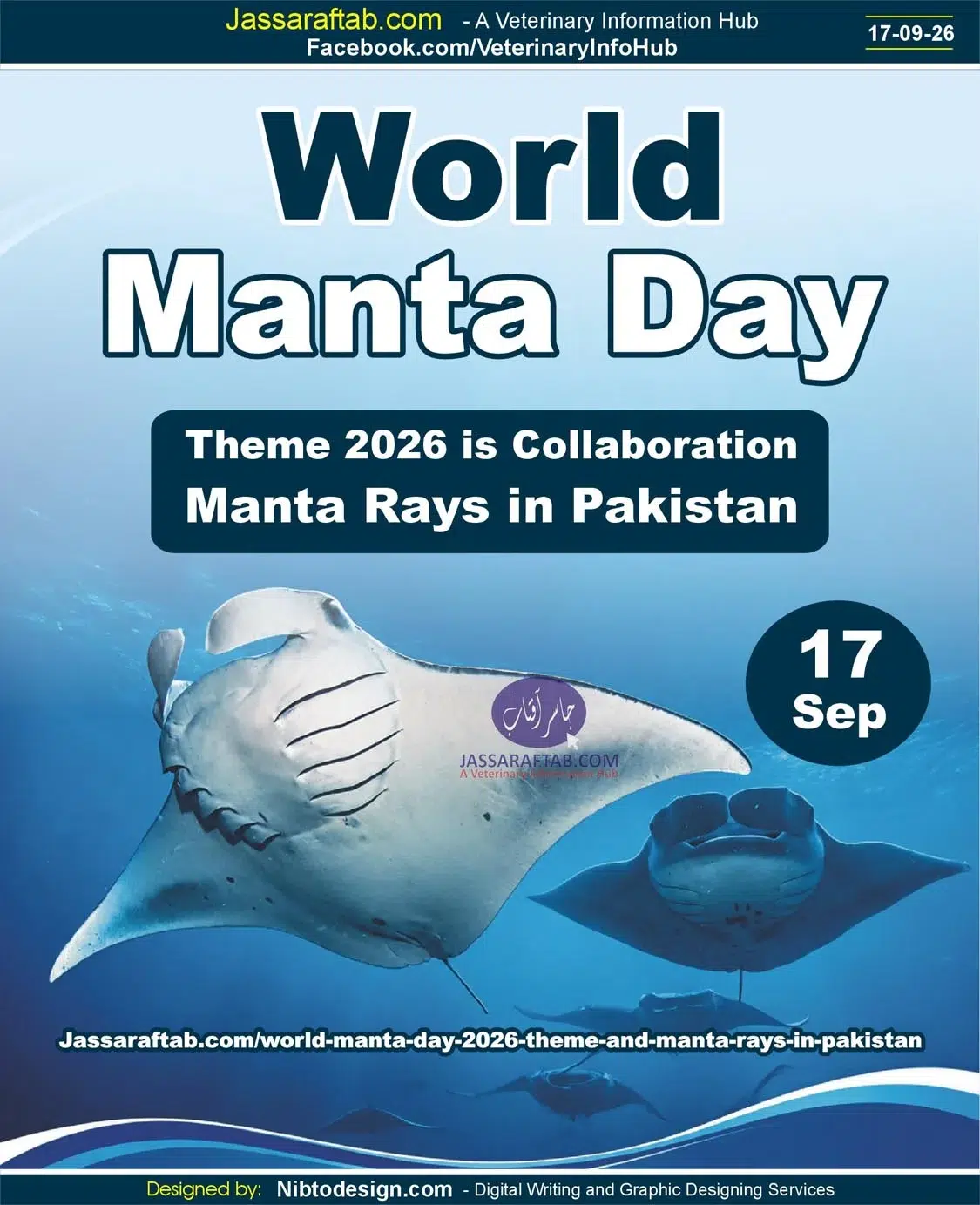
What is World Manta Day?
World Manta Day 2026 is an international awareness day dedicated to manta rays and devil rays. It is observed every year on 17 September. The day aims to increase public awareness of Manta Ray Conservation and major threats to Manta rays. It also encourages people to learn about manta rays, support research and conservation, share information and promote responsible marine tourism. Therefore, the World Manta Day 2026 theme is Collaboration. Importantly, Pakistan is also working for sharks and Conservation of Manta Rays through the launch of the National Plan of Action for Shark Conservation (2025-2035). Manta Ray Conservation in Pakistan. What are Mobulids?

All about World Manta Day & What are Manta Rays?
Manta rays belong to the family Mobulidae, which also includes several species commonly known as devil rays. They are closely related to sharks and other rays and have a skeleton made of cartilage rather than bone.

History of World Manta Day
World Manta Day was established by the Manta Trust, an international network working on manta and devil ray research and conservation.
The first World Manta Day was launched on 17 September 2020. The purpose was to create a dedicated annual opportunity to celebrate manta rays while increasing awareness of the threats affecting manta and devil ray populations.
Since then, World Manta Day has been marked through educational campaigns, social media activities, conservation initiatives and public awareness programs.
Different annual campaigns have highlighted different aspects of manta conservation. These have included issues such as climate change, education, tourism and the need for stronger conservation action.
World Manta Day 2026 Theme: “Collaboration”
Officially, World Manta Day 2026 theme is “Collaboration.”
The theme recognizes that manta and devil ray conservation cannot be achieved by scientists or conservation organizations working alone.
Manta rays move across large areas of the ocean. Their movements can cross national boundaries and different fishing zones. Therefore, effective conservation requires cooperation between countries, fisheries authorities, researchers and coastal communities.
The Manta Trust says its network brings together more than 30 affiliate projects around the world. Sharing information and coordinating conservation activities can help researchers and governments develop more effective measures for protecting mobulids.
The message behind the 2026 theme is particularly important for countries bordering the Indian Ocean, including Pakistan. Protection in one country’s waters can be undermined if animals are exposed to heavy fishing pressure elsewhere during their movements.
What are manta rays?
Manta rays are among the largest rays in the world.
The giant oceanic manta ray (Mobula birostris) can reach an enormous wingspan. The World Manta Day campaign notes that some individuals can reach approximately seven metres from wingtip to wingtip and weigh up to around two tonnes.
Despite their impressive size, manta rays are not predators of large marine animals.
They are filter feeders. They swim through the water and consume microscopic organisms, particularly zooplankton.
Mantas use their broad mouths and specialized filtering structures to capture food from the water. Their feeding behaviour can sometimes bring large numbers of animals together in productive areas of the ocean.
What are Mobulids?
Manta rays and devil rays are collectively known as mobulids. They belong to the family Mobulidae, a group of large, highly mobile cartilaginous rays found mainly in tropical and subtropical oceans.
The family includes manta rays and several species of devil rays. Mobulids are characterized by their broad, wing-like pectoral fins and distinctive cephalic fins located on either side of the mouth.
Major Threats to Manta and Devil Rays
There are following major threats to manta and devil rays.
Bycatch in fishing nets
One of the major threats is bycatch.
Manta and devil rays can become accidentally entangled in fishing nets while fishermen are targeting other species, particularly tuna and other pelagic fish.
Their large bodies and broad pectoral fins make escape from some types of fishing gear difficult.
The problem has also been documented in the northern Arabian Sea. A study presented to the Indian Ocean Tuna Commission reported that mobulid rays occur in coastal and offshore waters of Pakistan and can be caught as bycatch in pelagic gillnets targeting tuna and tuna-like species.
Targeted fishing of Manta Rays
In some parts of the world, manta and devil rays have been deliberately caught.
Their gill plates, which are structures used for filter feeding, have been traded for use in traditional practices and purported remedies, although there is no established scientific basis for many of these claimed medicinal uses.
The demand for gill plates has contributed to targeted fishing pressure on mobulid rays.
Climate change
Climate change is another emerging concern.
Manta rays depend heavily on planktonic food resources. Changes in ocean temperatures and productivity can influence the distribution and abundance of zooplankton.
Climate-related changes to marine ecosystems may therefore affect where manta rays can find sufficient food.
The World Manta Day campaign also identifies climate change and damage to important marine habitats as threats to manta populations.
Poorly managed tourism
Manta rays have become important attractions for diving and marine tourism.
Responsible tourism can contribute to conservation by creating economic incentives to protect manta habitats. However, excessive numbers of boats and divers, inappropriate approaches and disturbance at feeding or cleaning sites can negatively affect the animals.
Responsible tourism practices are therefore an important part of manta conservation.
Conservation of Manta and Devil Rays
International conservation efforts have increased significantly over the past two decades.
The Convention on the Conservation of Migratory Species of Wild Animals (CMS) lists a number of mobulid species under its appendices.
For example, the giant manta ray has been listed under CMS Appendix I and Appendix II since 2011 and is classified as Vulnerable by the IUCN.
The shortfin devil ray is also listed under CMS Appendices I and II. It occurs across areas including the Western Indian Ocean and Arabian Sea.
Conservation measures include:
- reducing accidental capture;
- preventing targeted fishing;
- protecting important feeding and aggregation areas;
- improving handling and release practices;
- monitoring populations;
- controlling illegal trade;
- improving fisheries regulations;
- educating fishing communities; and
- strengthening international cooperation.
The Manta Trust has also worked with international organizations and governments to support stronger protection for mobulid rays. Its conservation work has contributed to national protection measures in several countries.
Are Manta Rays Found in Pakistan?
Yes. Manta rays and several species of devil rays occur in Pakistani waters.
Pakistan has a long coastline along the Arabian Sea, providing habitat for a variety of sharks, rays and other marine species.
An Indian Ocean Tuna Commission document reports that mobulid rays occur in both coastal and offshore waters of Pakistan. It identified several mobulid species from Pakistani waters, including the giant manta ray.
There is also direct evidence of giant manta rays off the Karachi coast.
In 2022, two giant manta rays were photographed and filmed in waters southwest of Karachi. The animals were identified as giant manta rays (Mobula birostris). The report noted that the species had become extremely rare in Pakistani waters compared with historical observations.
Which manta and devil ray species occur in Pakistan?
Published information has documented several members of the Mobulidae family in Pakistani waters.
These include:
- Giant manta ray — Mobula birostris
- Reef manta ray — Mobula alfredi
- Spinetail devil ray — Mobula mobular
- Shortfin devil ray — Mobula kuhlii
- Chilean devil ray — Mobula tarapacana
- Bentfin devil ray — Mobula thurstoni
What is the Status of Manta Rays in Pakistan?
According to the Indian Ocean Tuna Commission document, mobulids or manta rays were relatively common in bycatch before 2015. However, there was an unprecedented decline in their landings at Karachi Fish Hardbound and other Pakistani landing centres after that period.
A decline in recorded landings does not automatically mean that the population has recovered. It may also reflect changes in fishing practices, fishing effort, distribution, reporting or the availability of the animals.
This is why long-term scientific monitoring is important.
The giant manta ray is particularly important in this context. A 2022 report stated that giant manta rays had become extremely rare in Pakistani waters and reported a sighting near Churna Island after several years without documented sightings.
Manta Ray Conservation in Pakistan and World Manta Day 2026 Theme
Pakistan has an important role in manta ray conservation because these remarkable animals occur in the country’s Arabian Sea waters. Scientific records have documented several mobulid species in Pakistani waters, including the giant manta ray.
One of Pakistan’s important conservation measures is the ban on catching mobulid rays introduced in 2016.
World Manta Day 2026 Theme collaboration raises awareness about
Churna Island–Sonmiani Bay
Churna Island–Sonmiani Bay is a marine area located along the coastal waters of Balochistan and Sindh, Pakistan. It extends from Cape Monz and Churna Island in the east to the waters off Ormara in the west.
The area includes epipelagic waters over sandy, muddy and rocky seabed habitats. It overlaps with two Ecologically or Biologically Significant Marine Areas (EBSAs): the Churna–Kaio Island Complex EBSA and the Malan–Gwadar Bank EBSA.
The region is also important for threatened marine species, including the Oceanic Manta Ray (Mobula birostris), as well as several species of devil rays and other sharks and rays.
Churna Island is recognized as an important feeding area for several threatened ray species and contains a notable assemblage of devil rays and oceanic manta rays.
Such recognition can help guide future marine spatial planning, fisheries management and conservation activities.
National Plan of Action for Shark Conservation 2025–2035
A major recent development is Pakistan’s National Plan of Action for the Conservation and Management of Sharks (NPOA-Sharks Pakistan 2025–2035). The Government of Pakistan unveiled the 10-year plan in September 2026 as the country’s first national action plan of this kind. Importantly, the plan covers all chondrichthyan species found in Pakistani waters, including sharks, rays, skates and chimaeras.
Pakistan’s First National Plan for Shark Conservation Announced
Although the plan’s primary focus is sharks, its framework is also relevant to manta and devil rays. It includes measures for better fisheries data, scientific research, reduction of bycatch mortality, habitat protection, stronger enforcement and engagement with fishing communities. The government has specifically stated that the management, data-collection and enforcement systems established through the NPOA will also benefit other elasmobranch species facing similar conservation pressures