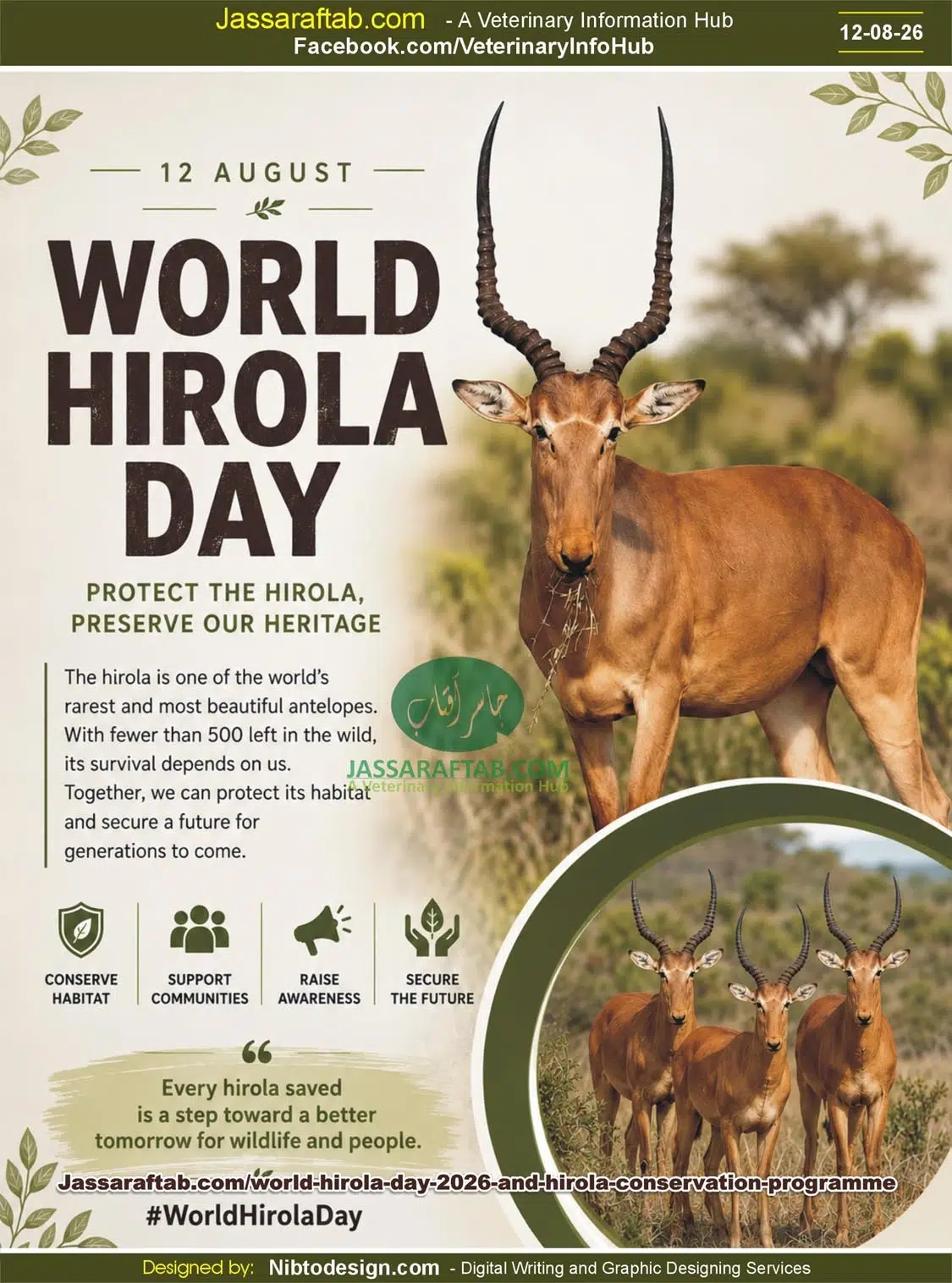
What is World Hirola Day 2026?
World Hirola Day 2026 is an annual conservation awareness day dedicated to the hirola antelope. It takes place every year on 12 August. The day highlights the urgent need to protect hirolas and hirolas habitats. Moreover, it also promotes hirola conservation. Hirola is a critically endangered antelope found in eastern Kenya near the Kenya-Somalia border. The Hirola Conservation Programme is working to prevent this unique endangered species from disappearing.

The Hirola Conservation Programme has played an important role in raising awareness and supporting community-based conservation. Its work includes research, habitat restoration, environmental education, protected areas, and anti-poaching efforts.
The hirola (Beatragus hunteri) is one of Africa’s rarest antelopes. It is also the only living species in the genus Beatragus. Therefore, its extinction would mean the loss of an entire evolutionary lineage.

History of World Hirola Day
The Hirola Conservation Programme established the day in 2015 with local and international partners. The date deliberately coincides with World Elephant Day. This connection helps bring attention to two threatened African species and highlights the wider conservation challenges facing African ecosystems.
World Hirola Day allows conservation organizations, communities, researchers, students and wildlife supporters to discuss the species and its declining population.
More importantly, it encourages action against hirola habitats destruction. Awareness alone cannot save the hirola antelope. Conservation must protect its habitat, reduce threats and involve the communities that share its landscape.
Why Is World Hirola Day Important?
World Hirola Day matters because the species faces an extremely high risk of extinction. Current conservation sources estimate that fewer than 500 hirolas remain in the wild. Some sources place the population at approximately 300–500 animals. There are also no established captive populations that could provide a simple safety net if the wild population disappears.
The hirola population once occupied a much larger area. However, its range has contracted dramatically. The species now survives mainly in eastern Kenya along the Kenya–Somalia border. A separate translocated population exists in Tsavo East National Park. Therefore, every remaining population is important.
World Hirola Day 2026 also highlights a larger conservation message. Protecting a species requires more than protecting individual animals. It requires protecting ecosystems, restoring habitats and working with local communities.
What Is a Hirola?
The hirola is a medium-sized antelope. It is also known as the Hunter’s hartebeest or Hunter’s antelope. Its scientific name is Beatragus hunteri. The species belongs to the family Bovidae.
The hirola has a distinctive appearance. It has a tan or reddish-brown coat. Older animals can develop darker coloration. It also has long, lyre-shaped horns. However, its most famous feature is the white facial markings around its eyes.
These markings have earned the hirola the nickname “four-eyed antelope.” The species also has large glands below its eyes. These glands help the animal mark its territory.
The hirola’s appearance makes it easy to recognize. However, its evolutionary uniqueness makes it even more important.
Where Do Hirolas Live?
Hirolas historically occupied grasslands and open savanna landscapes in northeastern Kenya and southern Somalia. Today, their remaining natural range is concentrated in eastern Kenya. Much of the population lives outside formally protected areas. This situation creates additional conservation challenges.
The species depends strongly on open grassland habitats. Therefore, changes in vegetation can have serious consequences. Increasing woody vegetation can reduce the availability of suitable grazing areas.
The species also shares its landscape with pastoral communities and livestock. As a result, conservation programmes must consider both wildlife and human livelihoods. Therefore, World Hirola Day plays an important role to combat destruction of hirola habitats.
ہیرولا کا عالمی دن، ہیرولا کی دلچسپ خصوصیات اور مسکن
Why Did the Hirola Population Decline?
The decline of the hirola resulted from several reasons. These reasons include;
Disease
Disease has played a role in the historical decline of hirola. The rinderpest epidemic caused major losses among many African wild and domestic herbivores. Conservation literature also identifies disease as one factor associated with the historical decline of hirola.
Disease risks can also increase when wildlife and domestic livestock share grazing and water resources.
Drought
Hirolas live in an arid and semi-arid environment. Therefore, drought can severely reduce available food and water. Prolonged drought can weaken animals and reduce reproduction. Climate variability can also increase pressure on already limited rangelands.
Habitat Loss
Habitat change represents one of the most important current threats. Hirolas depend on open grasslands. However, woody vegetation has expanded in parts of their former range. This change reduces suitable grazing habitat. It can also alter the ecological conditions that the species needs.
Predation
Predation represents another natural pressure. When populations become extremely small, however, even natural mortality can have a greater impact. A small population has fewer animals available to reproduce and recover from losses.
Competition With Livestock
Hirolas share their rangelands with domestic livestock. During periods of drought, competition for food and water can become particularly serious. Consequently, Hirola conservation programmes need to balance wildlife protection with the needs of pastoral communities.
Poaching and Human Pressure
Poaching and other forms of human pressure have also contributed to conservation challenges. However, conservationists increasingly recognize that local communities can become important partners in protecting wildlife. That approach changes conservation from an external activity into a shared responsibility.
The Hirola Conservation Programme (HCP) and World Hirola Day
Hirola conservation requires a combination of scientific research, habitat management and community participation. The Hirola Conservation Programme uses a multi-faceted approach. Its work includes research, environmental education, community engagement, protected-area establishment and anti-poaching efforts.
The programme began as a small community-based organization in 2008. It later registered formally as a nonprofit organization in 2014. Its initial focus was the hirola, although its conservation work has expanded to other endangered wildlife in eastern Kenya.
The Hirola Conservation Programme
The Hirola Conservation Programme (HCP) is an indigenous nonprofit organization based in Garissa, Kenya. It was created because of concern about declining hirola populations and the lack of local conservation capacity in the Kenya–Somalia border region. The programme takes a landscape-level approach.
It does not focus only on individual animals. Instead, it works to improve the wider conditions needed for hirola survival.
Its conservation activities include:
- Field-based research
- Population monitoring
- Habitat restoration
- Environmental education
- Community engagement
- Protected-area establishment
- Anti-poaching activities
- Support for local conservation capacity
Moreover, they are the founder of World Hirola day. So, on World Hirola Day 2026, the message is clear: protecting the hirola means protecting not only a rare antelope, but also the landscape and communities that are essential to its future.