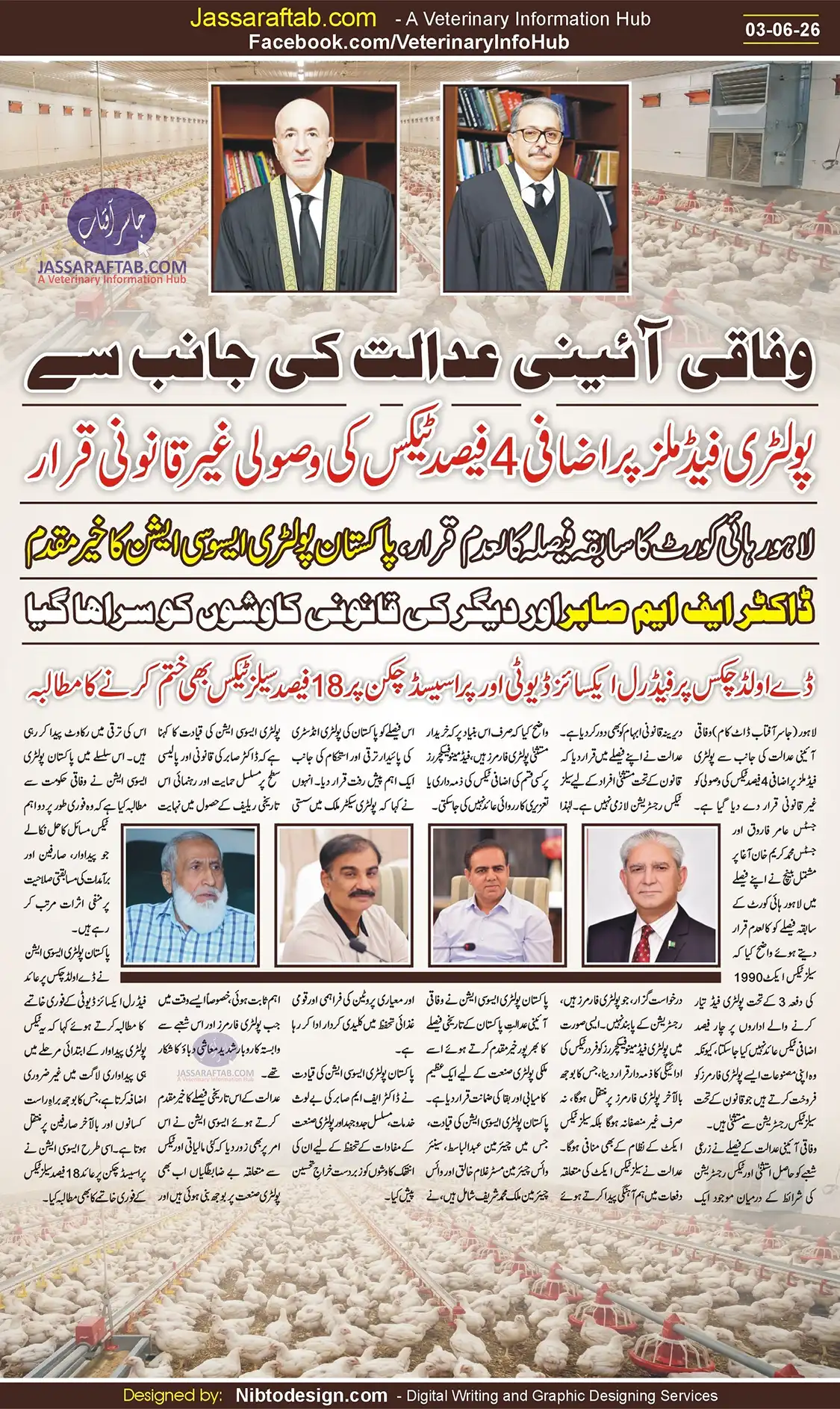
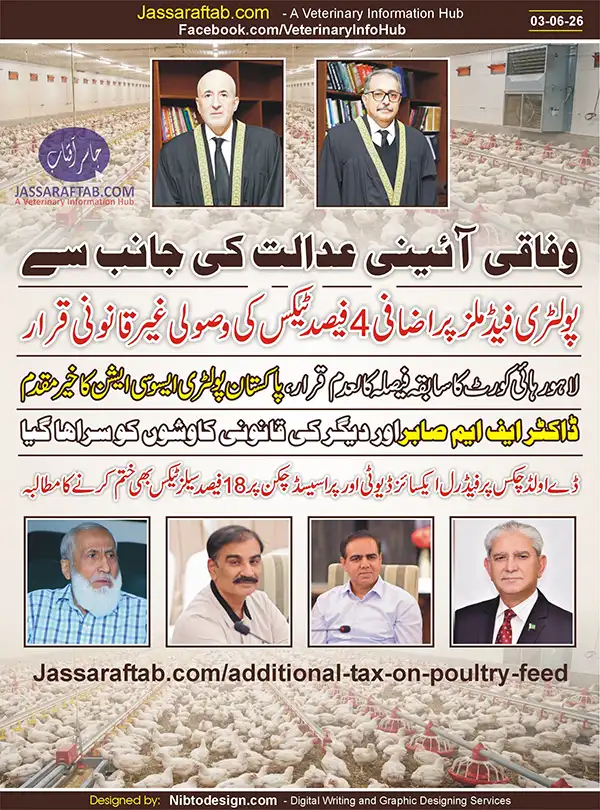
Federal Constitutional Court declared 4% Additional Tax on Poultry Feed Illegal
The Federal Constitutional Court of Pakistan has declared the additional tax on poultry feed illegal. The decision overturned an earlier ruling of the Lahore High Court and clarified the application of sales tax laws on poultry feed sales. This decision against “Further Tax” has provided significant relief to poultry feed manufacturers, poultry farmers, and the broader poultry industry.

A bench comprising Justice Aamir Farooq and Justice Muhammad Karim Khan Agha ruled that an additional 4 percent tax cannot be imposed on poultry feed manufacturers under Section 3 of the Sales Tax Act, 1990. The court observed that poultry feed manufacturers sell their products to poultry farmers who are exempt from sales tax registration under the law.
Additional Tax on Poultry Feed and Sales Tax Registration Clarified
The ruling has resolved a long-standing legal ambiguity regarding agricultural exemptions and sales tax registration requirements. According to the court, individuals and businesses that are legally exempt from taxation are not required to obtain sales tax registration.

Poultry Feed Companies in Pakistan
As poultry farmers fall within the exempt category, they cannot be compelled to register for sales tax. Therefore, imposing an additional tax on poultry feed manufacturers merely because they sell to exempt poultry farmers would be inconsistent with the structure and intent of the Sales Tax Act.
The court further stated that poultry feed manufacturers cannot be subjected to penalties or additional tax liabilities solely because their customers are exempt poultry farmers.
Pakistan Poultry Association Welcomes Relief from Additional Tax on Poultry Feed
The Pakistan Poultry Association (PPA) has strongly welcomed the Constitutional Court’s historic judgment, describing it as a major victory for the country’s poultry sector.
The association’s leadership, including Chairman Abdul Basit, Senior Vice Chairman Ghulam Khaliq, and Vice Chairman Malik Muhammad Sharif, stated that the decision supports the sustainable growth and stability of Pakistan’s poultry industry.
According to the association, the poultry sector plays a vital role in supplying affordable, high-quality protein to consumers and contributes significantly to national food security.
Pakistan Poultry Association – PPA
Poultry Industry Challenges
The poultry industry has faced increasing financial pressures in recent years due to rising feed costs, taxation issues, and production expenses. Industry representatives believe that the removal of the additional tax on poultry feed will help improve business confidence and reduce unnecessary financial burdens on producers.
Poultry Nutraceuticals, Poultry Feed Additives, and Poultry Feed Premixes Companies in Pakistan
The association also acknowledged the efforts of Dr. F.M. Sabir, praising his continued support and advocacy for the poultry sector. Industry leaders noted that his contributions at both legal and policy levels played an important role in securing this favorable outcome.
Poultry Industry Calls for Removal of Other Poultry Taxes
The association has urged the federal government to address other major tax-related concerns that are increasing production costs and reducing the sector’s ability to compete in domestic and export markets.
The Pakistan Poultry Association has called for the immediate abolition of the Federal Excise Duty imposed on day-old chicks. Industry representatives argue that this tax increases production costs at the very beginning of the poultry production cycle.
Poultry Pharmaceutical Companies in Pakistan
The association has also demanded the immediate removal of the 18 percent sales tax imposed on processed chicken products. According to industry stakeholders, this tax discourages investment in value-added poultry products, limits consumer demand, and reduces the competitiveness of Pakistan’s processed poultry sector. Removing the tax could encourage modernization, increase formal-sector participation, and support export growth.