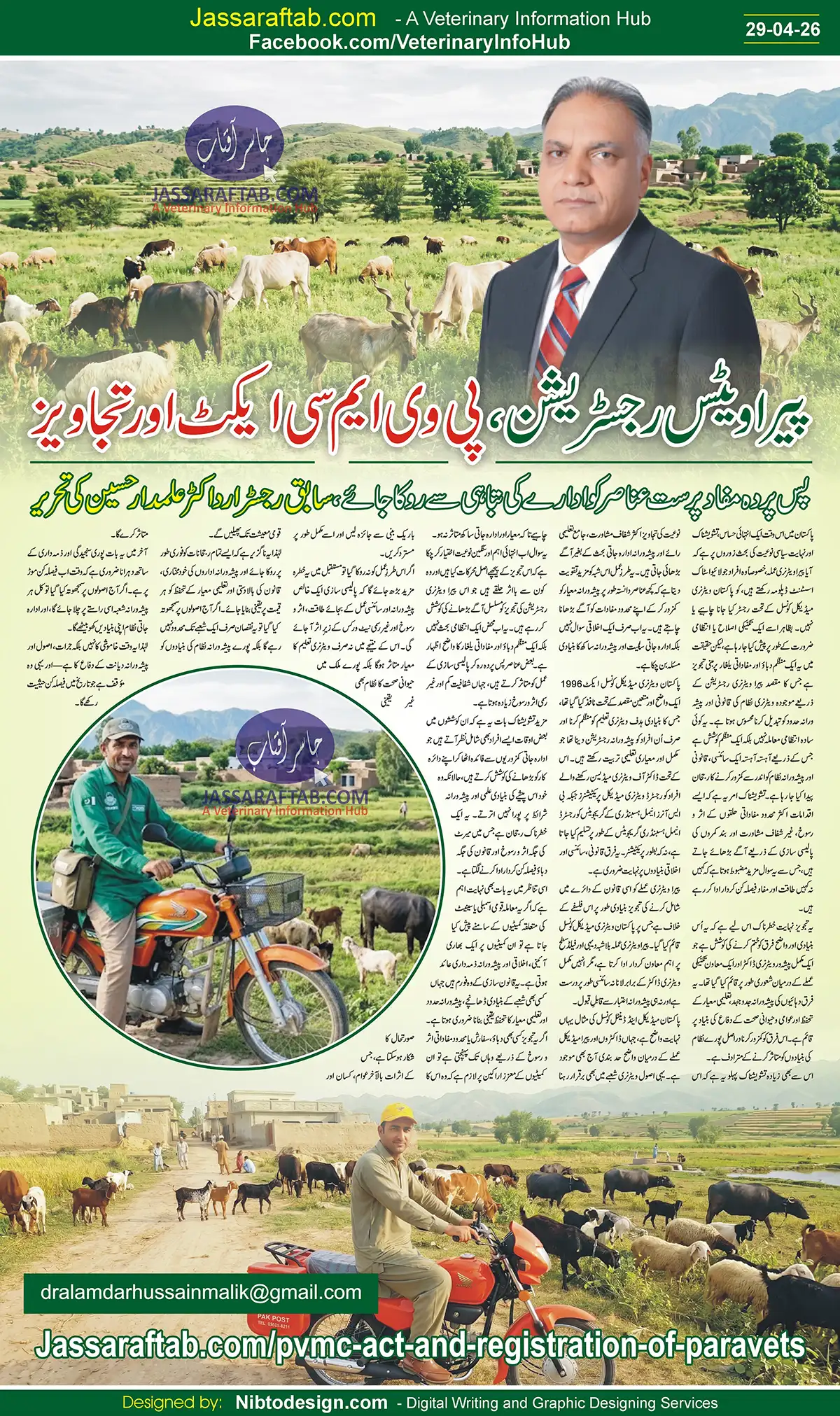
Attempt to Hijack PVMC Act 1996: Registration of Paravets Controversy
A highly contentious—and deeply troubling—debate is currently unfolding in Pakistan on the issue of registration of paravets. Whether para-veterinary personnel, particularly those holding Livestock Assistant Diploma (LAD) certificates, should be registered through the Pakistan Veterinary Medical Council, it is being discussed.

This is not a routine administrative adjustment, nor a benign policy refinement; it is, in essence, an attempt that many in the profession view as a “Attempt to Hijack PVMC Act 1996: A Direct Assault on Veterinary Profession in Pakistan.” The proposal reflects a dangerous confusion between supportive technical roles and fully qualified professional practice, blurring lines that were deliberately drawn to protect standards, public safety, and academic rigor.
Lack of Transparency
More concerning is the opaque manner in which such ideas are being promoted, often without transparent consultation, academic consensus, or institutional debate. It raises an unavoidable question: whose interests are truly being served by weakening established professional boundaries, and why is there an attempt to normalize such dilution under the cover of reform?

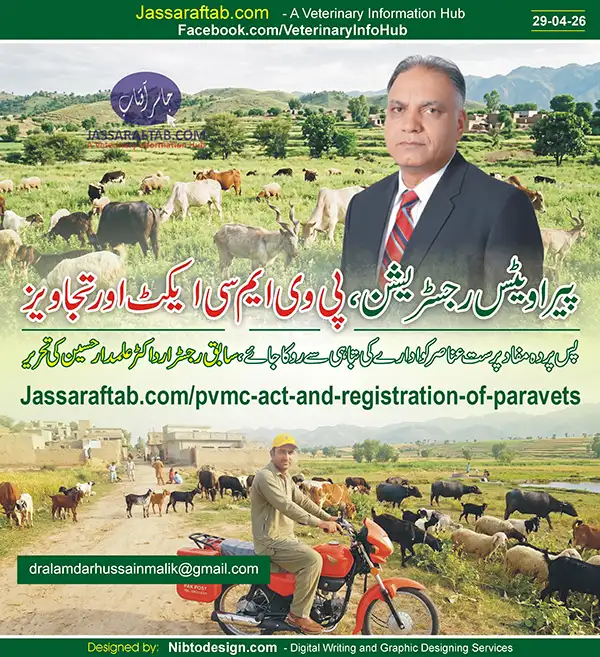
PVMC Act 1996 and Its Clear Stand Against Registration of Paravets
The Pakistan Veterinary Medical Council Act 1996 was enacted with a clear and focused mandate: to regulate veterinary education and ensure that professional registration is granted strictly on the basis of defined qualifications and categories. Under this framework, holders of the Doctor of Veterinary Medicine are registered as Registered Veterinary Medical Practitioners, whereas graduates with BS (Hons.) in Animal Husbandry are registered as Registered Animal Husbandry Graduates—not as practitioners.
پی وی ایم سی ایکٹ میں مجوزہ ترامیم، خصوصی تفصیلی رپورٹ
This distinction is not accidental; it is a carefully designed legal and professional safeguard that protects the integrity of veterinary practice, ensures competence in clinical decision-making, and preserves the credibility of animal health systems. It is the outcome of decades of institutional struggle and professional consensus.
The current proposal to include para-veterinary staff within this Act is therefore fundamentally flawed. It directly contradicts the philosophy on which the PVMC framework was built.
Support Role vs Professional Status
Para-veterinary personnel undoubtedly play an important supportive role in livestock management and field-level animal health delivery. Their contribution is practical and necessary at the grassroots level. However, elevating them to a status equivalent to qualified veterinary practitioners through legislative inclusion is neither justified nor scientifically defensible. It risks collapsing the essential distinction between technical assistance and professional medical authority.
Medical Sector Comparison
A useful comparison can be drawn with the Pakistan Medical and Dental Council. Since its establishment in the 1960s, despite multiple amendments and reforms, it has never incorporated paramedical staff into its regulatory definition of medical practitioners. The separation between doctors and paramedics remains clear, functional, and internationally consistent. The veterinary profession, therefore, should not be subjected to an experimental restructuring that even the human medical system has deliberately avoided.
Institutional and Ethical Risks of Registration of Paravets
This situation raises serious institutional and ethical concerns. Who is advancing this agenda, and on what professional or scientific basis? Is this driven by administrative convenience, institutional pressure, or the influence of groups seeking expanded recognition without equivalent academic qualification?
Whatever the underlying motivation, the consequences remain the same: dilution of standards, erosion of professional identity, and long-term damage to the credibility of veterinary education and practice in Pakistan. Such moves risk replacing merit-based professional recognition with hybrid, undefined categories that weaken regulatory clarity.
Alternative Framework
If there is a genuine need to regulate para-veterinary personnel, the correct and responsible approach is the establishment of a separate, well-structured regulatory framework tailored to their training, scope of work, and field responsibilities. This would ensure proper recognition without compromising the sanctity of veterinary professional practice or the legal integrity of the PVMC system.
Registration of Paravets as Institutional Regression
To proceed otherwise would be to erode the foundational principles of the Pakistan Veterinary Medical Council Act 1996. It would signal that professional boundaries are negotiable, and that rigorous academic training can be equated with short-term technical certification. This is not reform—it is institutional regression disguised as inclusivity.
Regulatory Weaknesses Before Expanding Registration of Paravets
Equally alarming is the internal reality of the Pakistan Veterinary Medical Council itself. The Council continues to face significant challenges in the effective regulation of veterinary education in Pakistan. Persistent gaps in accreditation enforcement, uneven monitoring of institutions, and structural weaknesses in oversight mechanisms remain unresolved.
In such a context, expanding the scope of an already overburdened regulatory body is not reform—it is administrative overreach. Before any consideration of expansion, the Council must first demonstrate full control over its existing mandate, ensuring consistency, transparency, and academic integrity across veterinary institutions in the country.
Parliamentary Responsibility in Registration of Paravets Decision
It is also imperative to draw the attention of the relevant committees of the National Parliament, where such proposals may eventually be presented for consideration. These parliamentary bodies carry a constitutional responsibility to safeguard the integrity of professional regulatory frameworks and must therefore exercise extreme caution before entertaining any amendment to the Pakistan Veterinary Medical Council Act 1996.
If this matter is ever successfully pushed to that level through lobbying or administrative pressure, it is essential that the committees critically evaluate its long-term implications rather than merely relying on superficial justifications.
Lawmakers must recognize that regulatory dilution under the guise of inclusion can cause irreversible damage to professional standards.
Protecting the Veterinary Profession from Registration of Paravets
Therefore, such committees should be fully sensitized, professionally briefed, and firmly advised to reject any attempt that seeks to blur the established distinction between qualified veterinary practitioners and para-veterinary support staff, ensuring that the sanctity of the veterinary profession remains protected at the legislative level.
Final Warning on Registration of Paravets and PVMC Act
It is therefore essential to state clearly and unequivocally that any attempt to forcibly insert para-veterinary cadres into the Pakistan Veterinary Medical Council Act 1996—an attempt rightly described as the “Attempt to Hijack PVMC Act 1996: A Direct Assault on Veterinary Profession in Pakistan”—represents more than a policy misstep.
It is an attempt to destabilize a carefully constructed professional system. Those promoting such changes must be openly identified and their motives critically examined within academic, professional, and public forums. The veterinary community cannot afford silence in the face of such structural encroachment.
Long-Term Impact on Veterinary Science
If such proposals are allowed to proceed unchecked, the result will be the gradual deprofessionalization of veterinary science in Pakistan. A discipline built on rigorous education, clinical competence, and scientific training risks being reduced to a loosely defined occupational field. This is not development; it is dismantling. It is the erosion of standards in real time, disguised as reform.
The veterinary profession, academic institutions, and policymakers must therefore respond with clarity, unity, and resolve.
Conclusion
The protection of professional boundaries is not a matter of institutional pride—it is a safeguard for animal health, public safety, and scientific integrity. Any compromise in this regard will have consequences that extend far beyond administrative structures and into the very credibility of the profession itself.