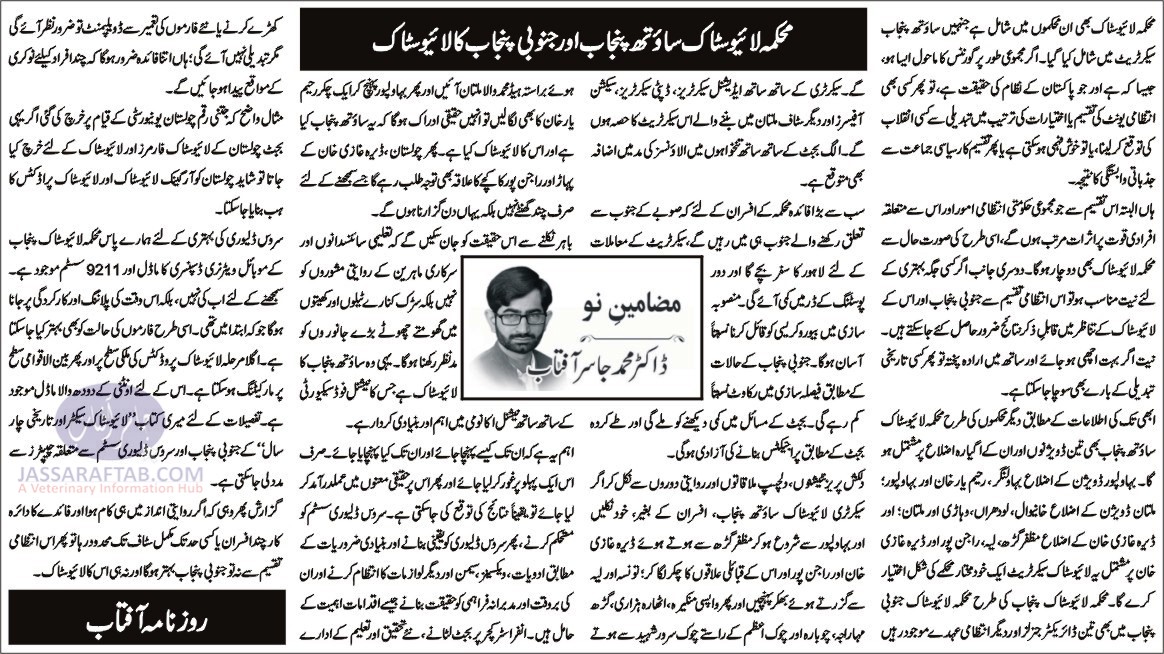
Livestock Department South Punjab and Livestock of South Punjab
Livestock Department South Punjab and Livestock of South Punjab. History of South Punjab Secretariat and Government of Punjab. Column by Dr. Jassar Aftab

چولستان اور چولستان ویٹرنری یونیورسٹی
The Livestock Department is among the departments that have been included in the South Punjab Secretariat. However, if the overall governance environment remains the same—as is the reality of Pakistan’s administrative system—then expecting a revolution merely from the division of an administrative unit or a change in the distribution of powers would either be wishful thinking or the result of emotional political attachment.
Certainly, the Livestock Department will also experience the administrative impact that this new arrangement will have on government affairs and departmental manpower. On the other hand, if there is genuine intent for reform, this administrative division can produce remarkable results for South Punjab and its livestock sector. With sincere commitment and strong leadership, it can even become the beginning of a historic transformation.
Structure of the Livestock Department South Punjab
According to the information available so far, the Livestock Department South Punjab will consist of the three divisions and eleven districts that now form the South Punjab Secretariat.
This new Livestock Secretariat will include:
- Bahawalpur Division: Bahawalnagar, Bahawalpur and Rahim Yar Khan
- Multan Division: Multan, Khanewal, Vehari and Lodhran
- Dera Ghazi Khan Division: Dera Ghazi Khan, Rajanpur, Muzaffargarh and Layyah
The department will function as an autonomous administrative unit. Similar to the Punjab Livestock Department, it will have three Director Generals along with other administrative positions. The Secretariat in Multan will include the Secretary, Additional Secretaries, Deputy Secretaries, Section Officers, and supporting staff. It is also expected to have its own development budget along with improved salaries and allowances.
Administrative Benefits of the New Secretariat
The biggest advantage for departmental officers is that officials belonging to South Punjab will remain closer to their home region. There will no longer be a need to travel repeatedly to Lahore for Secretariat matters, and concerns regarding distant postings will be reduced.
Planning and coordination with the bureaucracy will become comparatively easier. Decisions can be taken according to the realities of South Punjab, while budget planning and project execution can also become more flexible and responsive to local needs.
Understanding South Punjab Requires Going to the Field
However, meaningful reform will not come through presentations, meetings, or ceremonial visits.
If the Secretary Livestock South Punjab personally travels—without a large official entourage—from Bahawalpur through Muzaffargarh, Dera Ghazi Khan, Rajanpur and its tribal areas; then through Taunsa, Layyah and Bhakkar; returning via Mankera, Athara Hazari, Garh Maharaja, Chobara, Chowk Azam, Chowk Sarwar Shaheed and Head Muhammad Wala to Multan, before finally reaching Bahawalpur and Rahim Yar Khan, only then will the true realities of South Punjab and its livestock become visible.
Likewise, understanding Cholistan, the mountainous areas of Dera Ghazi Khan, and the Katcha belt of Rajanpur requires days of field observation rather than a few hours of official inspection.
Real Livestock Exists Beyond Offices
Only after visiting the field will policymakers realize that the future of South Punjab’s livestock sector cannot be shaped solely by traditional advice from academic experts or bureaucratic reports.
The real livestock of South Punjab consists of the millions of cattle, buffaloes, sheep, goats, and camels grazing in deserts, riverine belts, and agricultural fields. These animals form the backbone of both Pakistan’s national food security and the rural economy.
The Real Challenge Is Service Delivery
The most important question is not how many new offices are established but how government services reach livestock farmers.
If this single issue receives genuine attention, meaningful results can certainly be achieved.
Strengthening the livestock service delivery system, ensuring regular availability of medicines, vaccines, semen, and other essential inputs according to farmers’ needs, and making these services timely and accessible should become the department’s highest priorities.
Infrastructure Alone Will Not Bring Change
Constructing new buildings, establishing additional research institutions, opening educational campuses, or developing new government farms may demonstrate development on paper, but such measures alone will not transform the livestock sector.
Their primary benefit is often the creation of employment opportunities for a limited number of people rather than improving the lives of livestock farmers.
The Example of Cholistan
A clear example is Cholistan University.
If the financial resources spent on establishing the university had instead been invested directly in the livestock farmers and livestock resources of Cholistan, the region could potentially have become a national and international hub for organic livestock production and livestock products.
Successful Models Already Exist
Fortunately, successful models are already available.
The Mobile Veterinary Dispensary program introduced by the Punjab Livestock Department and the 9211 livestock service delivery system demonstrated how effective field-based service delivery could be. To understand their actual impact, policymakers should study the original planning and early implementation of these initiatives rather than their later condition.
Similarly, government livestock farms can also be improved.
Marketing Livestock Products Should Be the Priority
The first major objective should be developing markets for livestock products—first nationally and then internationally.
The successful camel milk model provides one practical example of how regional livestock resources can be linked to commercial markets.
Further guidance regarding South Punjab’s livestock potential and service delivery reforms can also be found in the chapters of my book, “Livestock Sector and Historical Four Years.”
The Success of South Punjab Depends on Its Priorities
If this administrative division continues to function in the traditional manner, and its benefits remain limited to a handful of officers or departmental staff, then neither South Punjab nor its livestock sector will experience meaningful improvement.
However, if the focus shifts from offices to farmers, from infrastructure to service delivery, and from administration to practical field solutions, the creation of the Livestock Department South Punjab can become a milestone in the development of Pakistan’s livestock sector.