

World’s best Technology Introduced for Indigenous Livestock Breeds Improvement and Preservation in Pakistan, says Chairman GCLI
For Indigenous livestock breeds improvement and Preservation, increase production, and strengthen the economic condition of farmers, regular scientific development has begun in the livestock breeding sector. Thanks to modern breeding technology, the foundation has been laid for the conservation and improvement of local breeds of livestock. The effective use of gender sorting technology can bring about a revolutionary change in the livestock sector. These views were expressed by Chairman Green Corporate Livestock Initiative (GCLI) Major General (R) Shahid Mahmood in a special discussion.

He emphasized that the primary focus of these initiatives is the protection and sustainable development of Pakistan’s indigenous livestock breeds. Scientific breeding methods are being used to ensure that valuable local genetics are preserved while improving productivity and performance.
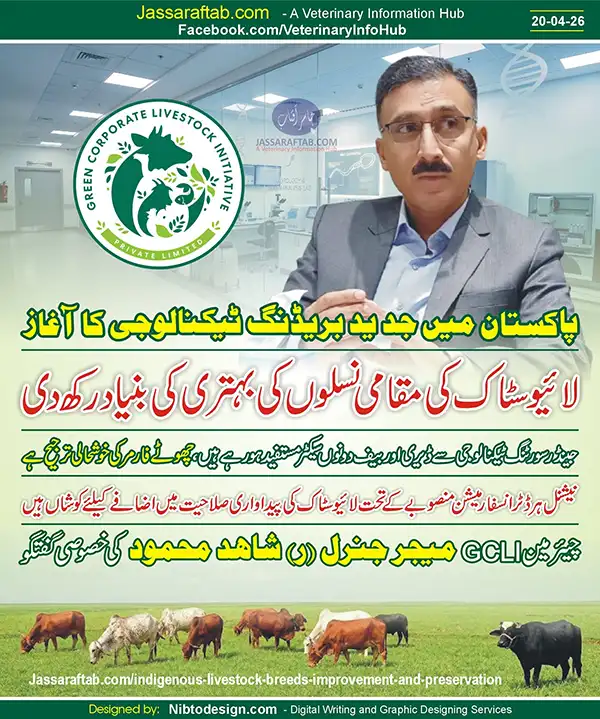
Gender Sorting Technology Supporting Local Breeds
He said that gender sorting technology is currently considered the most effective and modern technology in the livestock sector worldwide, through which farmers are provided with results according to their needs. Through this technology, it becomes possible to produce more female calves from local dairy breeds, which significantly increases milk production. At the same time, the production of male animals for meat is ensured. Thus, this technology strengthens both dairy and meat sectors while maintaining the integrity of local breeds.

Green Corporate Livestock Initiative (GCLI) under SIFC
Major General (retd) Shahid Mahmood said that the state-of-the-art Gender Sorting Laboratory established in Okara district by GCLI is equipped with modern equipment and facilities as per world standards. Gender sorted straws are being prepared with utmost expertise in this lab. This facility is a landmark step not only for technological advancement but also for safeguarding and improving local livestock genetics in Pakistan.
نامور میڈیا نمائندگان پر مشتمل وفد کا جی سی ایل آئی فارم اوکاڑہ کا دورہ
National Herd Transformation Drive for Livestock Breeds Improvement and Preservation
Under the National Herd Transformation Drive, gender sorted straws of prominent local breeds of Pakistan such as Sahiwal, Cholistani, Red Sindhi and Bhagnadi are being provided to farmers. In addition, straws of Nili Ravi, Kundi and Azakheli are also being supplied.
The genetic improvement of these indigenous breeds will not only enhance their milk production but will also improve disease resistance and adaptability to local climatic conditions. This approach for local livestock breeds improvement and Preservation ensures long-term sustainability and conservation of Pakistan’s rich livestock genetic resources.
IVF for local Indigenous livestock breeds improvement and Preservation
Major General (retd) Shahid Mahmood highlighted that work is also underway on high-quality gender-sorted embryos using modern embryo technology. This advancement will further accelerate the multiplication and preservation of superior local breed genetics.
Government Support for Indigenous Livestock Breeds Improvement and Preservation
He emphasized that government subsidies under the National Herd Transformation Project are providing significant support to farmers. The provision of free or subsidized gender-sorted straws to farmers registered in the Progeny Testing Program will promote the adoption of modern breeding technologies and ensure wider benefits for local breed development.
مفت اور رعایتی قیمت پر جینڈر سورٹڈ سٹراز کی فراہمی کا منصوبہ, ہرڈ ٹرانسفرمیشن
Strategic Use of Imported Genetics
He said that the import of world-class breeding bulls from countries like the US, Brazil and Australia is also contributing to genetic improvement. These include Friesian, Jersey, Nellore, Angus, Brayford, Brahman, Shar-e-Bray, Gir and Girolindo breeds.
However, this initiative ensures that crossbreeding and genetic enhancement are carried out carefully to strengthen productivity while preserving indigenous characteristics.
Empowering Farmers Through Indigenous Livestock Breeds Improvement and Preservation
Chairman GCLI Major General (retd) Shahid Mahmood stated that the ultimate goal is to strengthen small and medium farmers. By improving the productivity of local breeds through gender sorting and embryo technologies, farmers can increase both milk and meat production and significantly enhance their income.
This approach also reduces reliance on imports and opens new opportunities for exports, all while maintaining Pakistan’s native livestock resources.
Chairman GCLI Major General (retd) Shahid Mahmood expressed his commitment that under the Green Corporate Livestock Initiative, more advanced technologies will be introduced to further develop and protect local breeds.
This initiative of gender sorting technology will not only ensure self-sufficiency in the livestock sector but will also generate employment in rural areas and contribute to overall economic stability, with indigenous breed conservation at its core.


