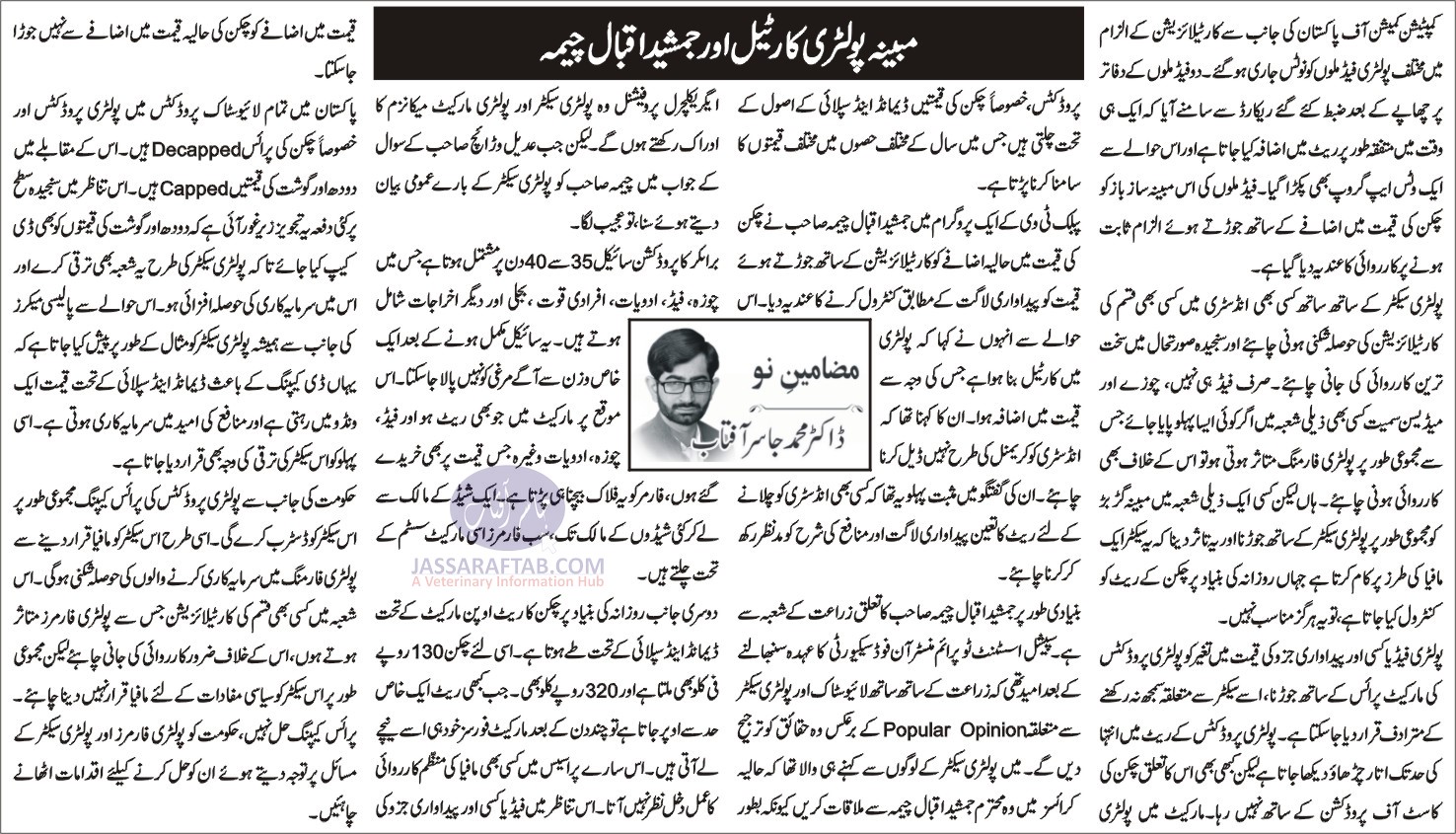
Poultry Cartel and Jamshed Iqbal Cheema – Competition Commission of Pakistan
The Competition Commission of Pakistan has issued notices to various poultry feed mills on charges of cartelization. Records seized after raids on the offices of two feed mills revealed that rates were allegedly being increased unanimously at the same time, and a WhatsApp group was also identified in this regard. The alleged collusion among feed mills has been linked to the increase in chicken prices, and the Commission has indicated that legal action will be taken if the allegations are proven. This column of Dr. Jassar Aftab highlights poultry industry, Poultry Cartel, poultry price capping and the Competition Commission of Pakistan

پولٹری فیڈ ملز کی مبینہ کارٹیلائزیشن، سی سی پی کی جانب سے شو کاز نوٹس جاری
کمپٹیشن کمیشن، کارٹیلائزیشن اور ڈیری ایسوسی ایشن ۔۔ مضامینِ نو، ڈاکٹر محمد جاسر آفتاب

Cartelization Should Be Addressed Without Targeting the Entire Poultry Sector
Any kind of cartelization in any industry, including the poultry sector, should be discouraged, and the strictest action should be taken in serious cases. Not only feed, but any sub-sector—including chicks, medicines, or other inputs—should be investigated if any practice adversely affects poultry farming as a whole. However, linking alleged irregularities in one sub-sector to the entire poultry industry and creating the impression that the poultry sector functions like a mafia that controls chicken prices on a daily basis is neither fair nor appropriate.
Chicken Prices Are Determined by Demand and Supply
Linking the price of poultry feed or any other production input directly to the market price of poultry products reflects a misunderstanding of how the poultry sector operates. Poultry product prices, especially chicken prices, are determined by the basic principles of demand and supply, which naturally result in price fluctuations throughout different times of the year.
Comments on Poultry Cartel
In a program on Public TV, Mr. Jamshed Iqbal Cheema linked the recent increase in chicken prices with cartelization and suggested that prices should be controlled according to the cost of production. He stated that a cartel exists in the poultry sector, which has caused prices to rise. At the same time, he also emphasized that the industry should not be treated like a criminal. The positive aspect of his remarks was his acknowledgment that prices in any industry should ideally reflect production costs and a reasonable profit margin.
Understanding the Poultry Market Mechanism
Mr. Jamshed Iqbal Cheema has primarily been associated with the agriculture sector. After assuming the office of Special Assistant to the Prime Minister on Food Security, it was expected that he would evaluate issues relating to agriculture, livestock, and poultry on the basis of facts rather than popular opinion. I was about to suggest that representatives of the poultry sector meet him during the current crisis because, as an agricultural professional, he was expected to understand the poultry production system and market mechanism. However, after listening to his general comments about the poultry sector in response to Adeel Warraich’s question, I found them surprising.
The Economics of Broiler Production
The production cycle of a broiler consists of 35 to 40 days, during which the farmer incurs expenses on chicks, feed, medicines, labor, electricity, and other production costs. Once this production cycle is complete, birds cannot be reared beyond a certain weight. Regardless of the prevailing market price or the prices paid for feed, chicks, medicines, and other inputs, farmers have no option but to sell their flock. Whether someone owns a single poultry shed or several sheds, all poultry farmers operate under the same market conditions.
Why Chicken Prices Fluctuate Naturally
The daily price of chicken is determined in the open market through demand and supply. That is why chicken may sell for Rs. 130 per kilogram at one time and Rs. 320 per kilogram at another. Whenever prices rise beyond a certain level, market forces generally bring them down within a few days. There is no evidence that an organized mafia controls this entire process. Therefore, increases in feed prices or any other production component cannot automatically be linked to temporary increases in chicken prices.
The Poultry Sector Is Already a De-Capped Market
Among all livestock products in Pakistan, poultry products—particularly chicken—are sold in a de-capped market. In contrast, milk and meat prices remain government-capped. For many years, policymakers have seriously discussed removing price controls on milk and meat so these sectors can develop in the same way as poultry and encourage greater investment. In fact, policymakers often cite the poultry sector as an example where de-capping allows prices to remain within a competitive range through demand and supply, creating incentives for investment and sectoral growth.
Price Capping Is Not the Solution
Government-imposed price controls on poultry products would disrupt the poultry sector as a whole. Likewise, portraying the entire poultry industry as a mafia discourages investment in poultry farming. Any proven case of cartelization that harms poultry farmers or market competition should certainly be dealt with under the law. However, it is neither accurate nor beneficial to label the entire poultry sector as a mafia for political purposes.
Price capping is not the solution. Instead, the government should focus on addressing the genuine challenges faced by poultry farmers and the poultry industry and take practical measures to resolve them.