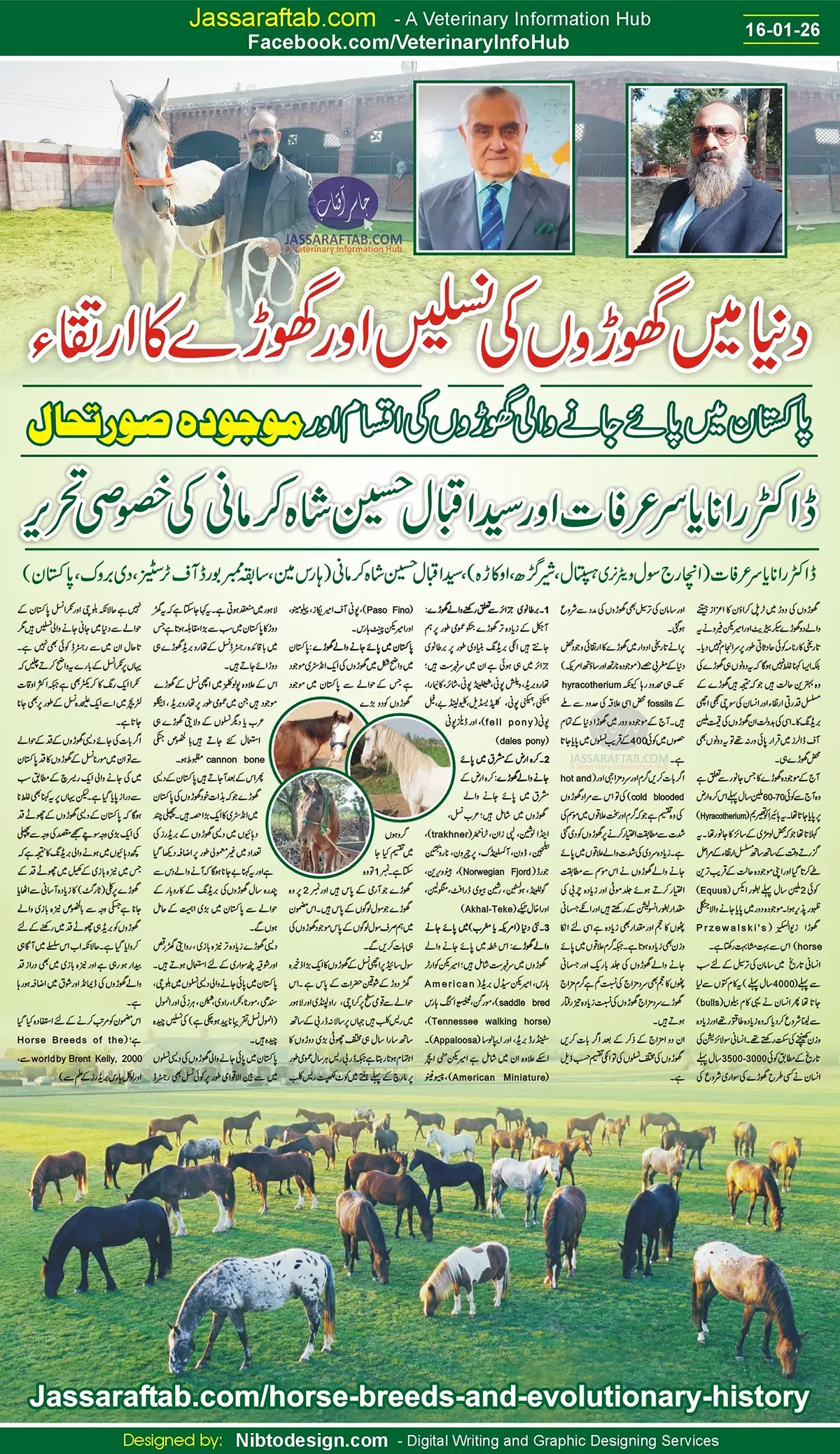
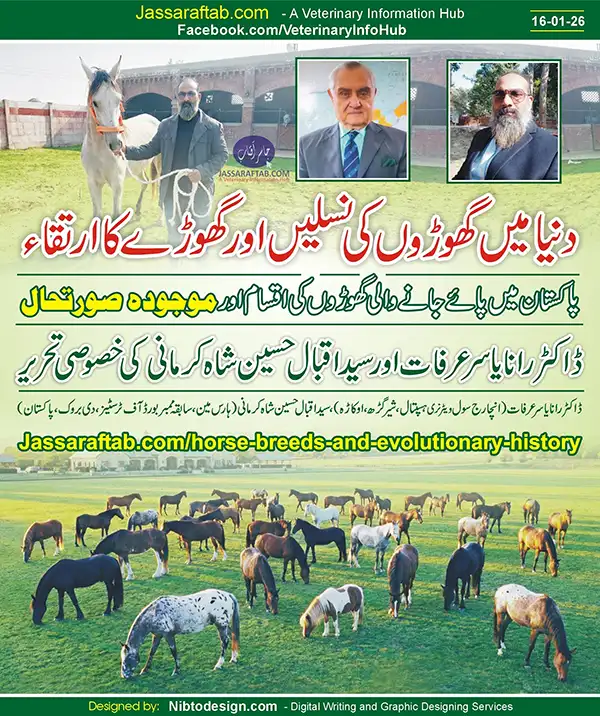
Horse Breeds of the World, Evolution of Horse and Its History – Horse Breeds in Pakistan and Their Current Status
Different Horse Breeds of the world, the evolution of horse and history of horse are discussed in this article. Moreover, Horse Breeds in Pakistan and their current is also discussed. This article is written by Dr. Rana Yasir Arafat (In-charge, Civil Veterinary Hospital, Shergarh, Okara) and Syed Iqbal Hussain Shah Kermani (Horseman, Former Member Board of Trustees, The Brooke Pakistan)


The legendary racehorses Secretariat and American Pharoah, winners of the prestigious Triple Crown, did not achieve greatness by chance. Their success reflects the combined result of millions of years of natural evolution and carefully planned selective breeding by humans. This scientific and strategic breeding is the reason these horses reached values of millions of dollars; otherwise, biologically, they were simply horses like any others.
Evolution of Horse and its History
The modern horse traces its origins back 60–70 million years to a small, fox-sized animal known as Hyracotherium. Over millions of years, this animal passed through several evolutionary stages. Around 2 million years ago, it appeared in a form very close to today’s horse under the genus Equus. Interestingly, the present-day wild horse, Przewalski’s horse, closely resembles this ancient evolutionary form.
Historically, humans first used animals for transportation about 4,000 years ago, initially relying on dogs. Later, bulls replaced dogs due to their superior strength and ability to pull heavier loads.
According to the history of human civilization, around 3,500–3,000 years ago, humans began riding horses and using them for transporting goods. This marked a turning point in agriculture, warfare, trade, and communication.
گھوڑوں کی نسلوں کے بیس لائن سروے کے حوالے سے ماسٹر ٹرینرز کی ٹریننگ کا انعقاد
In ancient times, horse evolution was limited mainly to the western regions of the world, particularly present-day North and South America. Fossil evidence of Hyracotherium has been found exclusively in these areas.
Today, horses are found across the globe, represented by nearly 400 recognized breeds.
Hot-Blooded vs Cold-Blooded Horses
The classification of horses into hot-blooded and cold-blooded types is based on their adaptation to different climates:
Cold-Blooded Horses
-
Found in colder regions
-
Thick skin and heavy fat layers for insulation
-
Larger muscle mass
-
Heavier body weight
-
High strength but slower speed
Hot-Blooded Horses
-
Adapted to warmer climates
-
Thinner skin and lighter muscle structure
-
Faster, more agile, and energetic
-
Preferred for racing and sports
Major Horse Breeds of the World
1. Horse Breeds from the British Isles
Most modern horse breeds were developed in the British Isles, including:
-
Thoroughbred
-
Welsh Pony
-
Shetland Pony
-
Shire
-
Connemara
-
Hackney & Hackney Pony
-
Clydesdale
-
Cleveland Bay
-
Fell Pony
-
Dales Pony
These breeds form the foundation of many modern equine bloodlines.
گدھوں کی کھالوں کی ایکسپورٹ پر پابندی ختم، گوادر فری زون میں سلاٹر ہاؤسز کو اجازت ۔۔ تفصیلی رپورٹ
2. Horse Breeds of the Eastern Hemisphere
Prominent eastern horse breeds include:
-
Arabian
-
Andalusian
-
Lipizzaner
-
Trakehner
-
Belgian
-
Percheron
-
Norwegian Fjord
-
Icelandic
-
Hanoverian
-
Don
-
Gotland
-
Holsteiner
-
Russian Heavy Draft
-
Mongolian
-
Akhal-Teke
Many of these breeds are renowned for endurance, elegance, and strength.
3. Horse Breeds of the New World (Americas)
Horse breeds developed in the Americas include:
-
American Quarter Horse
-
American Saddlebred
-
Morgan
-
Tennessee Walking Horse
-
Standardbred
-
Appaloosa
Other notable breeds are:
-
American Miniature Horse
-
Paso Fino
-
Pony of the Americas
-
Palomino
-
American Paint Horse
Horses in Pakistan and Current Status
Pakistan has a distinct and organized horse industry, broadly divided into two categories:
-
Horses owned by the Pakistan Army
-
Horses owned by civilian breeders and owners
This article focuses exclusively on civilian-owned horses.
A significant population of high-quality horses in Pakistan is owned by horse racing enthusiasts. Major race clubs operate in:
-
Karachi
-
Rawalpindi
-
Lahore
The most prestigious event is the Pakistan Derby, held annually—usually in the first week of March—at Kot Lakhpat Race Club, Lahore. Only registered Thoroughbred horses are allowed to participate, making it the country’s most elite racing competition.
High-quality horses are also maintained by polo clubs across Pakistan. These typically include:
-
Thoroughbreds
-
Anglo-Arabs
-
Other imported breeds
Special emphasis is placed on horses with strong cannon bones, essential for polo performance and durability.
Indigenous Horse Breeds of Pakistan
Pakistan’s local (indigenous) horse breeds form a major segment of the equine industry. Over the last few decades, the number of local breeders has increased significantly. The next 10–15 years are expected to be crucial for horse breeding in Pakistan. These are commonly used for
-
Tent pegging
-
Traditional horse dancing
-
Recreational riding
Indigenous Horse Breeds in Pakistan
-
Balochi
-
Sindhi
-
Morna
-
Nukra
-
Ravi
-
Sheen
-
Harzai
-
Anmol (almost extinct)
None of Pakistan’s indigenous horse breeds are currently internationally registered. However, Balochi and Nukra horses are well known globally in association with Pakistan.
It is important to note that Nukra is often considered a color characteristic, though it is frequently described as a separate breed in equine literature.
Circle International – Advanced Machinery for Dairy and Agriculture Sectors
Height and Selective Breeding of Local Horses
Research conducted in Pakistan indicates that Morna horses have the greatest average height among indigenous breeds.
However, the generally smaller stature of Horse Breeds in Pakistan is largely due to intentional selective breeding over recent decades. In tent pegging, shorter horses make it easier to pick up the peg (target). As a result, breeders deliberately favored smaller horses.
Fortunately, awareness is increasing, and there is now a growing demand for taller, well-built horses, even in tent pegging sports.
The Future of Horse Breeding in Pakistan
Pakistan possesses a rich equine heritage with strong potential for growth. With improved awareness, scientific breeding practices, and international registration of indigenous Horse Breeds in Pakistan, the country’s horse industry can achieve global recognition in the coming years.
Disclaimer
This article has been compiled using references from Horse Breeds of the World by Brent Kelly (2000) and insights from local horse breeders.