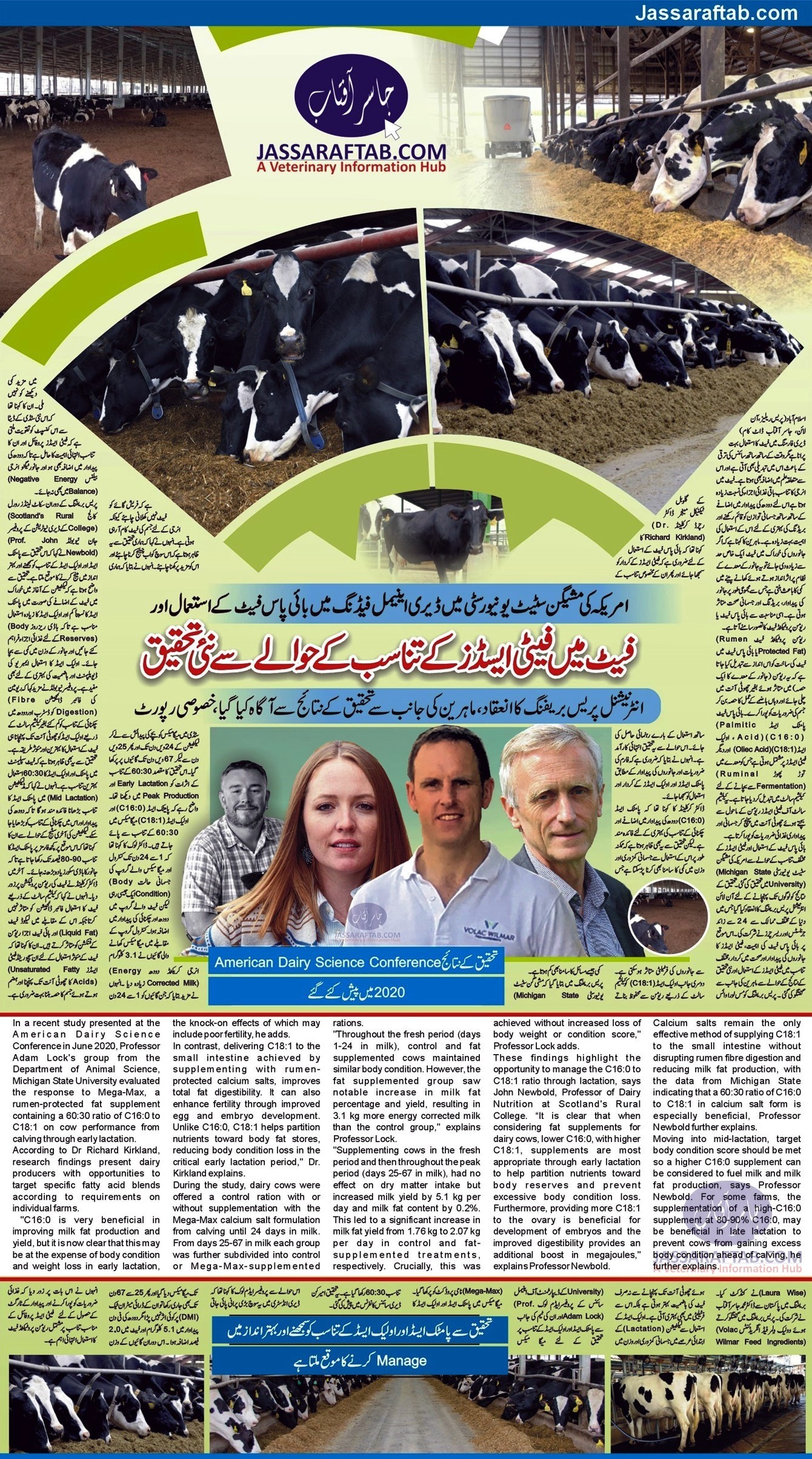
New Research on fatty acids profile of bypass Fat for cattle
Michigan State University conducted new research about fatty acids profile of bypass Fat for cattle. Importantly, cow requires fat as a source of energy. On the other hand, if ratio of fat exceeds from the certain limit, it negatively affects the digestion. Furthermore, this situation leads to reduction in production and overall disturbance in breeding and reproduction. In fact, By pass fat for cow crosses the rumen as protected and utilized in small intestine. In rumen protected fat, palmitic acid, acetic acid and oleic acids are converted to calcium salt. It protects this fat from fermentation in rumen. However, this research was on mega max of Megalac.

In this research, researchers fed maga-max in fresh cows (1-24 days) and found positive results. Moreover, this article gives the details of this research. Furthermore, this also elaborates the different functions of fatty acids in cows in different ratios.
مشیگن سٹیٹ یونیورسٹی میں ڈیری اینیمل فیڈنگ میں فیٹ کے استعمال اور
بائی پاس فیٹ میں فیٹی ایسڈز کے تناسب کے حوالے سے نئی تحقیق

پولٹری اور لائیوسٹاک فیڈ میں جانوروں کی فیٹ کے استعمال بارے ویٹرنری یونیورسٹی میں مشاورتی اجلاس
پاکستان فیڈ سٹفس ڈیٹا بیس ۔۔ جانوروں کی خوراک میں استعمال ہونے والے اجزاء کا غذائی تجزیہ
بہتر پیداوار اور آسان مینجمنٹ کے لئے ڈیری شیڈ کا ڈیزائن کیسا ہونا چاہئے ؟؟ ڈاکٹر طاہرہ جمیل
ہیٹ سٹریس جیسے مسئلے پر خوراک اور مینجمنٹ سے کیسے قابو پائیں؟ عالمی ماہرین کا میڈیا کو جاری بیان
Mega-Max Fat Supplement in Early Lactation Dairy Cows
In a recent study presented at the American Dairy Science Conference in June 2020, Professor Adam Lock’s group from the Department of Animal Science, Michigan State University evaluated the response to Mega-Max, a rumen-protected fat supplement containing a 60:30 ratio of C16:0 to C18:1 on cow performance from calving through early lactation.
Benefits and Limitations of C16:0 – Bypass Fat for Cattle
According to Dr Richard Kirkland, research findings present dairy producers with opportunities to target specific fatty acid blends according to requirements on individual farms.
“C16:0 is very beneficial in improving milk fat production and yield, but it is now clear that this may be at the expense of body condition and weight loss in early lactation, the knock-on effects of which may include poor fertility, he adds.
Advantages of C18:1 Supplementation – Bypass Fat for Cattle
In contrast, delivering C18:1 to the small intestine achieved by supplementing with rumen-protected calcium salts, improves total fat digestibility. It can also enhance fertility through improved egg and embryo development. Unlike C16:0, C18:1 helps partition nutrients toward body fat stores, reducing body condition loss in the critical early lactation period,” Dr. Kirkland explains.
During the study, dairy cows were offered a control ration with or without supplementation with the Mega-Max calcium salt formulation from calving until 24 days in milk. From days 25-67 in milk each group was further subdivided into control or Mega-Max-supplemented rations.
Research on Bypass Fat for Cattle
“Throughout the fresh period (days 1-24 in milk), control and fat supplemented cows maintained similar body condition. However, the fat supplemented group saw notable increase in milk fat percentage and yield, resulting in 3.1 kg more energy corrected milk than the control group,” explains Professor Lock.
“Supplementing cows in the fresh period and then throughout the peak period (days 25-67 in milk), had no effect on dry matter intake but increased milk yield by 5.1 kg per day and milk fat content by 0.2%. This led to a significant increase in milk fat yield from 1.76 kg to 2.07 kg per day in control and fat-supplemented treatments, respectively. Crucially, this was achieved without increased loss of body weight or condition score,” Professor Lock adds.
Implications for Fat Supplementation Strategies
These findings highlight the opportunity to manage the C16:0 to C18:1 ratio through lactation, says John Newbold, Professor of Dairy Nutrition at Scotland’s Rural College. “It is clear that when considering fat supplements for dairy cows, lower C16:0, with higher C18:1, supplements are most appropriate through early lactation to help partition nutrients toward body reserves and prevent excessive body condition loss. Furthermore, providing more C18:1 to the ovary is beneficial for development of embryos and the improved digestibility provides an additional boost in megajoules,” explains Professor Newbold.
Calcium Salts as a Delivery Method for C18:1
Calcium salts remain the only effective method of supplying C18:1 to the small intestine without disrupting rumen fibre digestion and reducing milk fat production, with the data from Michigan State indicating that a 60:30 ratio of C16:0 to C18:1 in calcium salt form is especially beneficial, Professor Newbold further explains.
Fat Supplementation in Mid and Late Lactation
Moving into mid-lactation, target body condition score should be met so a higher C16:0 supplement can be considered to fuel milk and milk fat production, says Professor Newbold. For some farms, the supplementation of a high C16:0 supplement at 80-90% C16:0, may be beneficial in late lactation to prevent cows from gaining excess body condition ahead of calving, he further explains.