


World Pangolin Day | Protecting the World’s Most Trafficked Mammal | What is a Pangolin? | Pangolin Conservation | Myth of Pangolin Scales Medicine | Facts about Pangolins
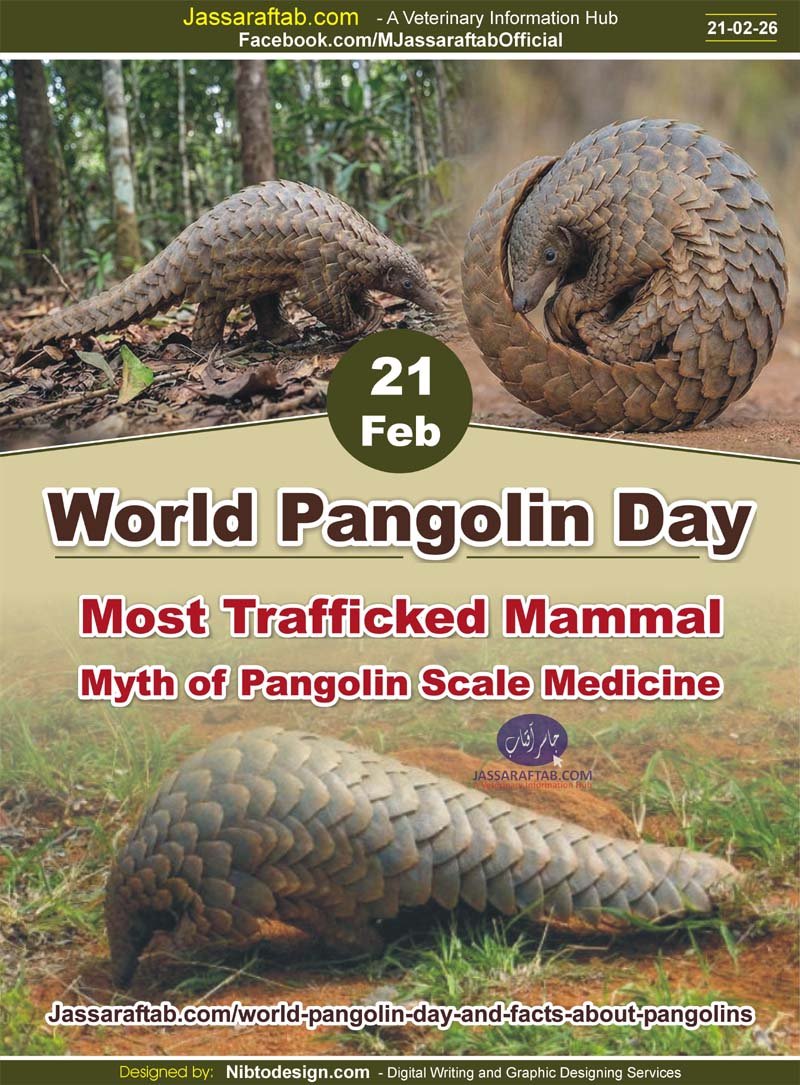
Every year, people celebrate World Pangolin Day on the third Saturday of February. This day raises awareness about Pangolins, to protect the most trafficked mammal on Earth. It also highlights important facts about pangolins and Myth of pangolin scale medicine . Although many people have never seen a pangolin, these shy animals play an important role in nature. However, their survival is now under serious threat. Therefore, World Pangolin Day provides an opportunity to raise awareness about pangolin conservation and stop illegal wildlife trade.


History of World Pangolin Day
World Pangolin Day was launched in 2012 by Rhishja Cota, a passionate advocate against wildlife trafficking. She led the World Pangolin Day platform until 2022. After that, she handed over its leadership to Save Pangolins to continue its global mission.
Rhishja has worked with organizations such as USAID Wildlife Asia. In addition, she authored the Pangolin Species Identification Guide and organized important conservation workshops. Her field research is also extensive. For example, she has studied illegal wildlife markets in Hanoi as well as the rainforests of Sumatra.
Moreover, she has actively participated in CITES meetings, where she pushed for stronger protection of wildlife. As a result, her work has gained recognition in both media and academic circles. Today, her contributions continue to support and shape global pangolin conservation efforts.
What is a Pangolin?
Pangolins are often called “scaly anteaters.” However, they are not related to anteaters. Instead, they belong to their own unique group of mammals.
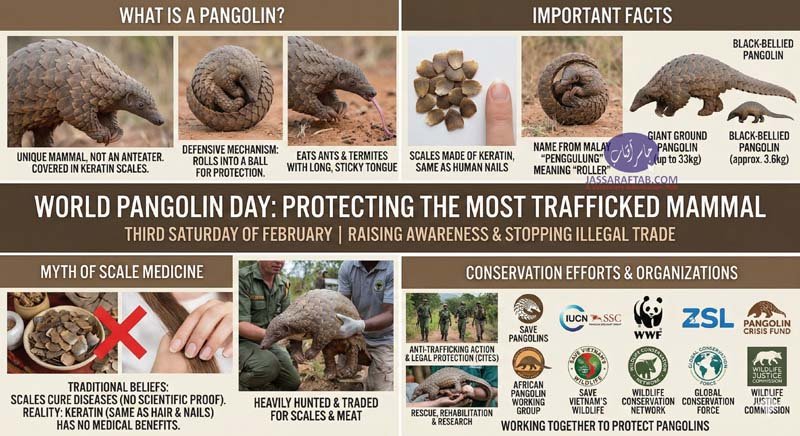
They have hard, overlapping scales made of keratin. Interestingly, this is the same material found in human nails. When threatened, a pangolin curls into a tight ball. As a result, its scales protect it from predators.
Moreover, pangolins have long, sticky tongues. They use these tongues to eat ants and termites. In fact, one pangolin can eat millions of insects every year.
World Pangolin Day | پینگولن کا عالمی دن ، ہسٹری-خصوصیات اور دیگر معلومات
Important Facts About Pangolins
Pangolins are unique mammals with special features and behaviors. They play an important role in nature. However, they are also among the most threatened animals in the world. There are some important facts about pangolins.
Rolling Gives Them Their Name
Pangolins protect themselves by rolling into a tight ball. This action hides their soft underbelly and shows only their hard scales. As a result, predators cannot easily attack them.
In fact, their name comes from the Malay word “penggulung,” which means “roller.” Therefore, their behavior directly inspired their name. This is an interesting fact about pangolins.
Different sizes of Pangolins
Pangolins vary greatly in size. The giant ground pangolin is the largest species. It can weigh about 33 kg and grow up to 180 cm long.
On the other hand, the black-bellied pangolin is much smaller. It weighs only about 3.6 kg. Thus, pangolins range from small tree-dwellers to large ground animals.
Defensive Mechanism of Pangolins
One of the most important facts about pangolins includes their defence mechanism. Pangolins have unique and effective ways to protect themselves from predators. Pangolins have overlapping scales. These scales act like armor. They protect pangolins from biting insects like ants and termites, as well as from the sharp teeth and claws of predators such as leopards, lions, tigers, and hyenas. As a result, pangolins can survive many attacks.
In addition, pangolins use several defensive behaviors. They roll into a tight ball to protect their soft underbelly and raise their sharp scales to face danger. Moreover, they can release a strong-smelling liquid from their anal glands, which helps to deter predators.
However, all these strategies are purely defensive. Pangolins are not aggressive animals. Instead, they are shy and solitary, usually living alone or sometimes in pairs.
Myth of Pangolin Scales Medicine and World Pangolin Day
Pangolin scales use in medicine also includes in important facts about pangolins. Pangolin scales are often believed to have healing properties. In some traditional medicine systems, especially in China and Vietnam, people use them to treat conditions like rheumatism, skin diseases, and problems with milk production. However, these beliefs are not supported by science.
In reality, pangolin scales are made of keratin, which is the same substance found in human hair and nails. Therefore, they have no proven medical benefits.
Despite this fact, pangolins are still heavily hunted and traded for their scales. As a result, illegal wildlife trade continues to threaten their survival. Therefore, World Pangolin Day helps to create awareness protecting them from extinction.
Most trafficked Mammal on Earth
Between 2000 and 2013, traffickers killed and illegally traded more than one million pangolins. They capture these animals to supply the exotic pet trade and traditional medicine markets, especially in China and Vietnam. In addition, some people consider pangolin meat a luxury food, while others use their scales for rituals and jewelry.
Poachers use extremely cruel methods to hunt pangolins. They often light fires to smoke pangolins out of their burrows or tree hollows. After that, they capture and beat the animals so they cannot escape. In many cases, they then kill them in inhumane ways.
Why Are Pangolins the Most Trafficked Mammal?
Pangolins are the most trafficked mammals because people hunt and sell them for several reasons. Many people use Pangolin scales in traditional medicine, especially in parts of Asia, even though science shows no proven health benefits. In addition, some consider pangolin meat a luxury food, which increases demand in illegal markets. Traders also target pangolins because they are easy to catch. When threatened, pangolins roll into a ball instead of running away, so poachers can easily pick them up.
Moreover, traffickers earn high profits from selling pangolins, pangolin scales and their body parts, which encourages illegal hunting. Weak law enforcement in some regions also allows this trade to continue. As a result, illegal wildlife trade has pushed pangolins toward extinction.
Pangolin Conservation and World Pangolin Day
Conservationists, governments, and organizations are working together to protect pangolins from extinction. They use different strategies to stop illegal trade, protect habitats, and raise awareness. These efforts are very important because pangolins are highly endangered.
One major effort for pangolin conservation is legal protection. All eight species of pangolins are protected under international laws, and authorities have banned their trade under the CITES agreement. As a result, countries are taking stronger actions against wildlife crime. In addition, governments are improving wildlife laws and increasing penalties for illegal trade.
Another key effort is anti-trafficking action. Law enforcement agencies conduct raids, monitor markets, and arrest traffickers involved in illegal wildlife trade. Moreover, international cooperation helps track smuggling networks and stop cross-border trafficking. World Pangolin Day also highlights important facts about pangolins.
Organizations working to protect Pangolins and World Pangolin Day
Many organizations around the world are actively working to protect pangolins through research, law enforcement, rescue, and awareness programs. Save Pangolins is a leading organization that focuses on raising global awareness and supporting pangolin conservation projects in Asia and Africa. The IUCN SSC Pangolin Specialist Group brings together experts to develop pangolin conservation strategies and guide governments.
In addition, the World Wildlife Fund (WWF) works to reduce illegal trade and strengthen wildlife protection laws. The Zoological Society of London (ZSL) supports research and anti-poaching efforts, while the Pangolin Crisis Fund provides financial support to pangolin conservation projects worldwide. In Africa, the African Pangolin Working Group works on research, rescue, and training wildlife professionals.
Similarly, Save Vietnam’s Wildlife rescues and rehabilitates pangolins and educates local communities. Organizations like Wildlife Conservation Network and Global Conservation Force support field conservation and anti-poaching activities. Moreover, the Wildlife Justice Commission helps stop illegal wildlife trade by assisting in the investigation and arrest of traffickers. Together, these organizations play a vital role in protecting pangolins and ensuring their survival.


