


Southern Giraffe Birth for the first time in Pakistan at DanZoo Karachi and Best Giraffe Management at Zoo
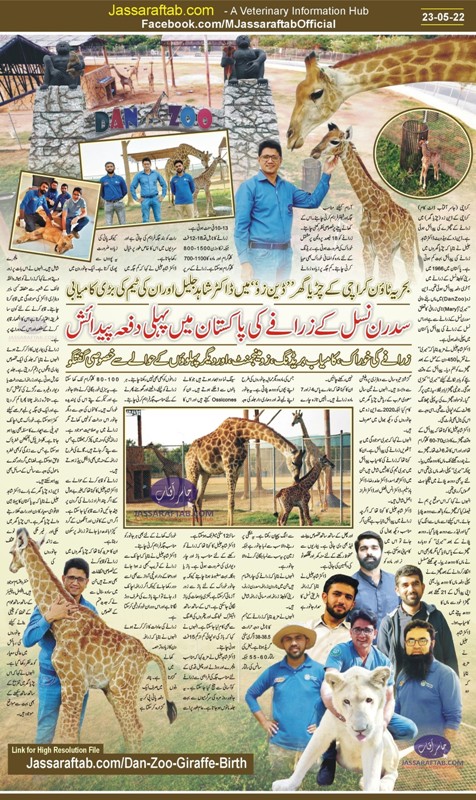
Birth of Zarafa | Southern Giraffe Birth for the first time in Pakistan at DanZoo Karachi. A giraffe calf has been born at the Dan Zoo in Karachi. Dr. Shahid Jalil, the head vet of the Dan Zoo, said that giraffe births are very rare in zoos. The last birth of a reticulated giraffe in Pakistan was in 1966. The giraffe named “Mary” who became a mother at the Dan Zoo belongs to the Southern giraffe breed and this is the first time a giraffe of this breed has been born in Pakistan. This article highlights the various aspects of successful Giraffe Management at zoo, including housing, feeding, breeding and health management.

Dr. Shahid Jalil further said that “Mary” gave birth to the calf after a pregnancy of about 450 days. At the time of birth, “Mary” stood up to take the baby out. As soon as the calf came out, it fell to the ground. This first jump of the newborn calf was from a height of 6 feet. Due to this, its umbilical cord also broke.
Dr. Shahid Jalil said that at the time of birth, the calf weighed 60-70 kilograms and was 6 feet tall. The calf did not drink its mother’s milk for 15 hours. Since “Mary” was a first-time mother, she was also hesitant to breastfeed.
Hand Feeding Helped the Newborn Calf Survive
He said that on this occasion, we decided to hand-feed the calf. For this, it was separated from its mother and fed from a feeder. After breastfeeding, “Mary” was brought back to the calf, but still it did not drink its mother’s milk. After waiting for six hours continuously, the calf drank its mother’s milk for the first time. That is, 21 hours after its birth, the calf was able to drink its mother’s milk on its own.
Dr. Shahid Jalil further said that he has been associated with the veterinary profession for the past thirteen years. He worked at the Riyadh Zoo in Saudi Arabia for three years, while he has been busy taking care of animals at the Dan Zoo since 2020.
He said that this is the eighth giraffe birth in my presence. He said that the successful birth of the giraffe includes the efforts of my team, which includes Dr. Muhammad Asad, Dr. Hamid Raza, Dr. Had Saleem, Dr. Anas Afzal and Dr. Afraz Ajmal.
Feeding and Giraffe Management
Dr. Shahid Jalil said that although birth in giraffes is rare, if proper care is taken, it can be successful. The male and female should be provided with a suitable place and shelter for rest. Special attention should be paid to their food and drink. Giraffes need a diet containing 18 percent protein. The female should also be provided with additional food for breeding. Many giraffes should not be kept in a small space.
He said that we have 4 male and 7 female giraffes. They are given fresh fodder and fruits as well as special pellet feed. To protect them from diseases, foot and mouth vaccinations are done.
Housing and Giraffe Management
Dr. Shahid Jalil said that a proper fence and enclosure is required to keep a giraffe. The fence or enclosure should be very strong because this animal can try to force its way through the fence for food. A wooden or metal fence can be installed. Along with this, electric fencing and stone fencing can also be used. He said that the height of the fence should be at least 15 feet.
Dr. Shahid Jalil added that giraffes can be easily managed by providing a proper cage and adequate space for running and walking. This animal quickly becomes accustomed to daily activities. It is usually provided with a closed space at night and special care is taken of it in winter.
Dr. Shahid Jalil said that giraffes should never be kept in a small space. Every giraffe should be provided with a suitable place to lie down, stand up and move around. Every animal should also be provided with a suitable place to eat.
Dr. Shahid Jalil said that one should never approach a giraffe suddenly and keep it away from loud, explosive sounds because if a giraffe suddenly gets scared, it runs towards its enclosure and can injure itself in the process.
Biological Characteristics and Feeding Habits of Giraffes
Dr. Shahid Jalil said that the giraffe is an African mammal whose female, like other mammals, feeds her young with milk. This animal is distinguished by its tall stature and striped skin. It is the tallest land animal and the tallest ruminant on earth.
He said that there are four types of giraffes, including the northern giraffe, the southern giraffe, the reticulated giraffe and the Masai giraffe.
He further said that the normal body temperature of a giraffe is 38-38.5 degrees Celsius. The pulse rate is 55-60 while the respiratory rate is 10-13 per minute. The normal height of a giraffe is 12-18 feet while the weight of a male can be 800-1500 kilograms and that of a female can be 700-1100 kilograms. The giraffe has two horn-like protrusions on its head which are covered with black hair. They are called Ossicones and can be up to 12 centimeters in size.
While mentioning the habits of giraffes, he said that a giraffe spends most of the day eating. It can survive by drinking water only once in a few days because it meets most of its water needs from plants. An animal can eat up to 80-100 kilograms in a day. It is a herbivorous ruminant animal and the leaves of the kekar tree are its favorite food. Other animals do not eat this tree because of the thorns, but giraffes have this ability. The giraffe holds the branch in its mouth and shakes it, which makes the leaves fall. Like cows, giraffes also have dental pads in their mouths.
Veterinary Giraffe Management
Regarding controlling a giraffe, Dr. Shahid Jalil said that if a few people sit on the neck of a giraffe without making it unconscious, it can be controlled. If a cloth is tied around its ears and eyes, the giraffe remains calm.
He further said It was said that zoos also have special arrangements for controlling giraffes, ranging from simple stalls to modern special cages. He emphasized that giraffes should always be controlled in the presence of a veterinary doctor specializing in the field of wildlife. The method to be adopted for control depends on the purpose of control and its duration.
Mentioning giraffe diseases, he said that a certain skin disease causes sores on the legs. The skin itches and the giraffe tries to rub it against a tree or wall, etc. The affected giraffe reduces its movement and may stand in one place for a long time. A sudden change in diet also causes bloating. Clostridial infection can be dangerous and can be life-threatening. Dust and dirty environment in the air can also cause respiratory problems.
Dan Zoo Karachi Offers International Standard Facilities
About the Den Zoo, Dr. Shahid Jalil said that this is Pakistan’s first international standard zoo open day and night. This zoo has more than ninety different species of local and foreign animals. Along with animal welfare, international standards have been kept in mind in the housing of animals to ensure the safety of the public. He said that this zoo has many opportunities for entertainment as well as learning.
بہتر فونٹ سائز کیلئے پیج پر کلک کریں


