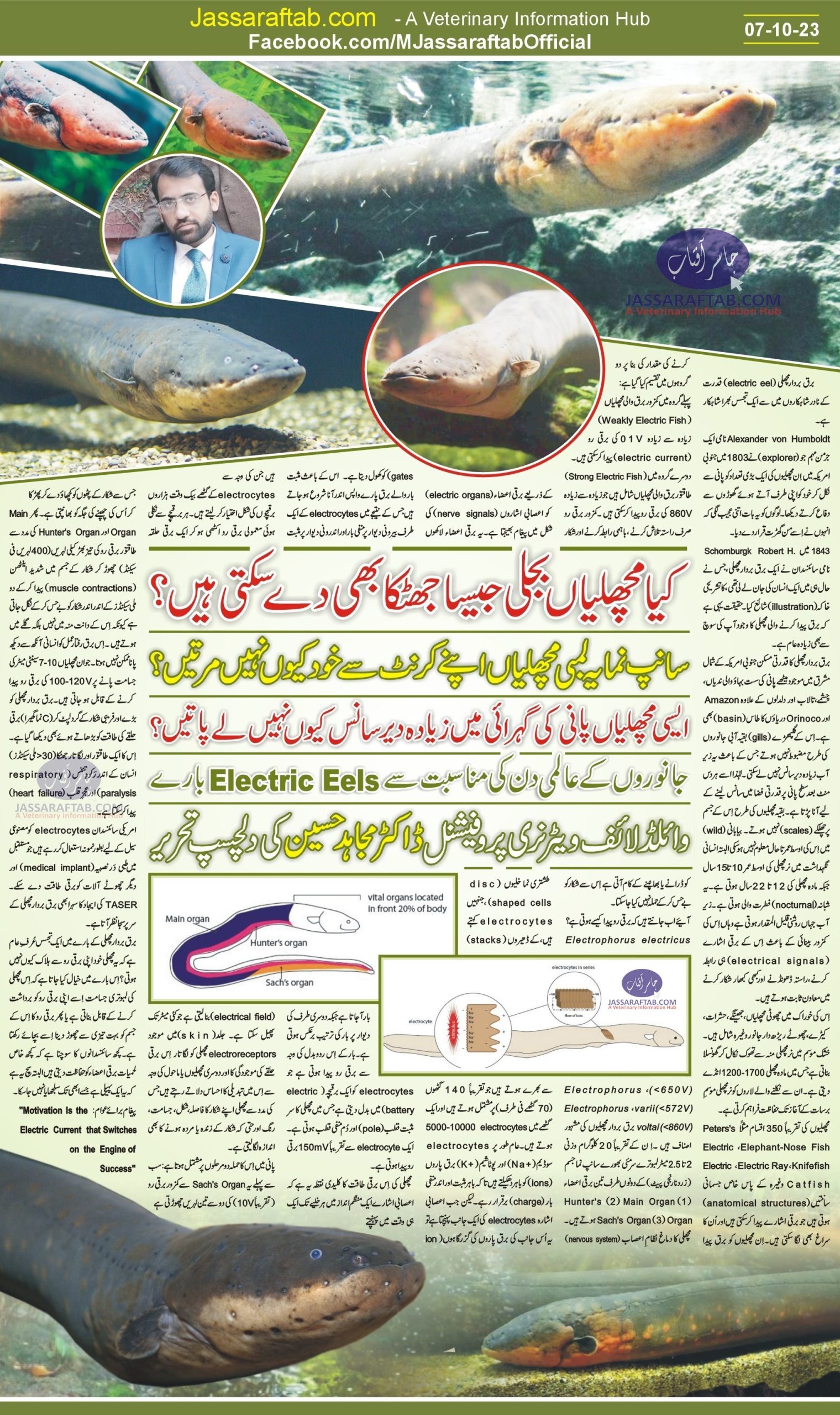
Information about Electric Eel Electricity
The Electric Eel is a strange creature. This snake like fish produces electric shock. For Electric Eel Electricity, there are electrocytes in its body which are found in electric organs. This fish uses these organs along with brain and nervous system to produce electric shock. Three Types of these organs produce electric current of different intensity. First they produce low shock and then high shock to attack the prey. Moreover, high shock can cause lungs paralysis and heart failure in human body. This article is written by Dr. Mujahid Hussain.

Its habitat is the fresh water of South America in addition to Orinoco and Amazon Electric Eel. Because of weak gills, this fish cannot stay long in deep water. They have to move out of water after every ten minutes. Besides these characteristics, they have nocturnal behavior.
مختلف جانوروں میں بچے کی پیدائش کا حیران کن عمل، ڈاکٹر مجاہد حسین کی دلچپسپ تحریر

The electric eel is one of nature’s rarest and most curious creatures. In 1803, a German explorer named Alexander von Humboldt saw a large number of these fish emerging from the water in South America and defending themselves from approaching horses. People found it so strange that they dismissed it as a hoax.
In 1843, a scientist named Robert H. Schomburgk published an illustration of an electric fish that had recently killed a man. The truth is that electric fish are more common than you might think.
Habitat, Lifestyle and Reproduction
The natural habitat of the electric fish is the slow-flowing freshwater rivers, springs, ponds and swamps in northeastern South America, as well as the basins of the Amazon and Orinoco rivers. Its gills are not as strong as those of other aquatic animals, which means it cannot breathe underwater for long. Therefore, it has to come to the surface of the water every ten minutes to breathe in natural air.
Unlike other fish, it does not have scales on its body. Its average lifespan in the wild is not yet known, however, in human care, the average lifespan of males is 10 to 15 years, while that of females is 12 to 22 years. It is nocturnal in nature. Due to its poor eyesight, its electrical signals are the only means of communication, navigation and sometimes hunting.
Its diet includes small fish, shrimp, insects, worms, small vertebrates, etc. In the dry season, the male fish builds a nest by spitting out saliva from his mouth, in which the female fish lays 1200-1700 eggs. The male fish protects the larvae that emerge from them until the beginning of the rainy season.
Types of Electric Eel and Electric Eel Electricity Capacity
About 350 species of fish, such as Peters’s Elephant-Nose Fish, Electric Knifefish, Electric Ray, Electric Catfish, etc., have special anatomical structures that can generate and detect electrical signals. These fish are divided into two groups based on the amount of electricity they generate:
In the first group, weakly electric fish can generate a maximum electric current of 0.1V. The second group (Strong Electric Fish) includes fish with strong electricity that can produce a maximum of 860V of electricity. The weak electric current is only used to find a way, communicate with each other, and scare or detect prey. It cannot be used to stun the prey and attack.
Process of Electric Eel Electricity Production
Now let’s know how electric current is produced?
Electrophorus electricus (<650V), Electrophorus varii (<572V), Electrophorus voltai (<860V) are famous species of electric fish. They have a 2 to 2.5 meter long gray-brown snake-like body (yellowish-orange belly) weighing about 20 kg and three electric organs (1) Main Organ (2) Hunter’s Organ (3) Sach’s Organ on both sides.
The fish brain sends messages in the form of nerve signals to the electric organs through the nervous system. These electric organs are filled with stacks of millions of disc-shaped cells called electrocytes, which consist of about 140 clusters (70 clusters per side), and each cluster contains 5,000-10,000 electrocytes.
Normally, electrocytes push sodium (Na+) and potassium (K+) ions out to maintain a positive charge on the outside and a negative charge on the inside. But when a nerve signal reaches one side of the electrocytes, it opens the ion gates on that side. This causes the positively charged particles to start flowing back in, resulting in a negative charge on the outer wall of the electrocytes on one side and a positive charge on the inner wall, while the charge arrangement on the other side is reversed.
This reversal of charge creates an electric current that turns the electrocytes into an electric battery, with the fish’s head as the positive pole and the tail as the negative pole. An electric current of about 150mV is generated from an electrocyte. The key point of this electric power of the fish is that nerve signals reach each cell at the same time in an organized manner, due to which the bundles of electrocytes simultaneously take the form of thousands of electrocytes.
The small electric currents emitted from each electrocyte come together to form an electric field that can extend for several meters. Electroreceptors in the skin constantly sense the presence of this electric field and its changes due to other fish or the environment, which helps the fish estimate the distance, shape, size, color, and even whether the prey is alive or dead.
Hunting Mechanism and Electric Eel Electricity Attack
Its attack in the water consists of two stages: First, it releases two to three waves of weak electric current (about 10V) from the Sach’s Organ, which causes the prey’s muscles to twitch and reveal its hiding place. Then, with the help of the Main Organ and Hunter’s Organ, it releases fast, intense waves of powerful electric current (400 waves per second), causing severe muscle contractions in the body of the prey, and within two milliseconds, it numbs and swallows the prey because its teeth are not in the mouth but in the throat. It is not possible to see this lightning-fast process with the human eye.
Young fish are capable of generating an electric current of 100-120V when they reach a size of 7-10 centimeters. The electric fish has also been observed to coil itself around large, deceptive prey (a C-shaped coil) to increase the strength of the electric field. A powerful and sustained shock (>30 milliseconds) can cause respiratory paralysis and heart failure in humans.
Electric Eel Electricity – Inspiration for Science and Technology
US scientists are using electrocytes as a model for artificial cells that could power medical implants and other small devices in the future. The invention of the TASER is also credited to the head of the electric fish.
Electric Eel Electricity not Harmful to itself!
A common curiosity about the electric fish is why it doesn’t die from its own electric current. It is thought that the elongated size of this fish enables it to withstand its own electric current, or that the electric current leaves its body very quickly to protect it. Some scientists think that certain proteins protect the electric organs, but the truth is that this is a puzzle that has not yet been solved.
Message to the Public
“Motivation Is the Electric Current that Switches on the Engine of Success”