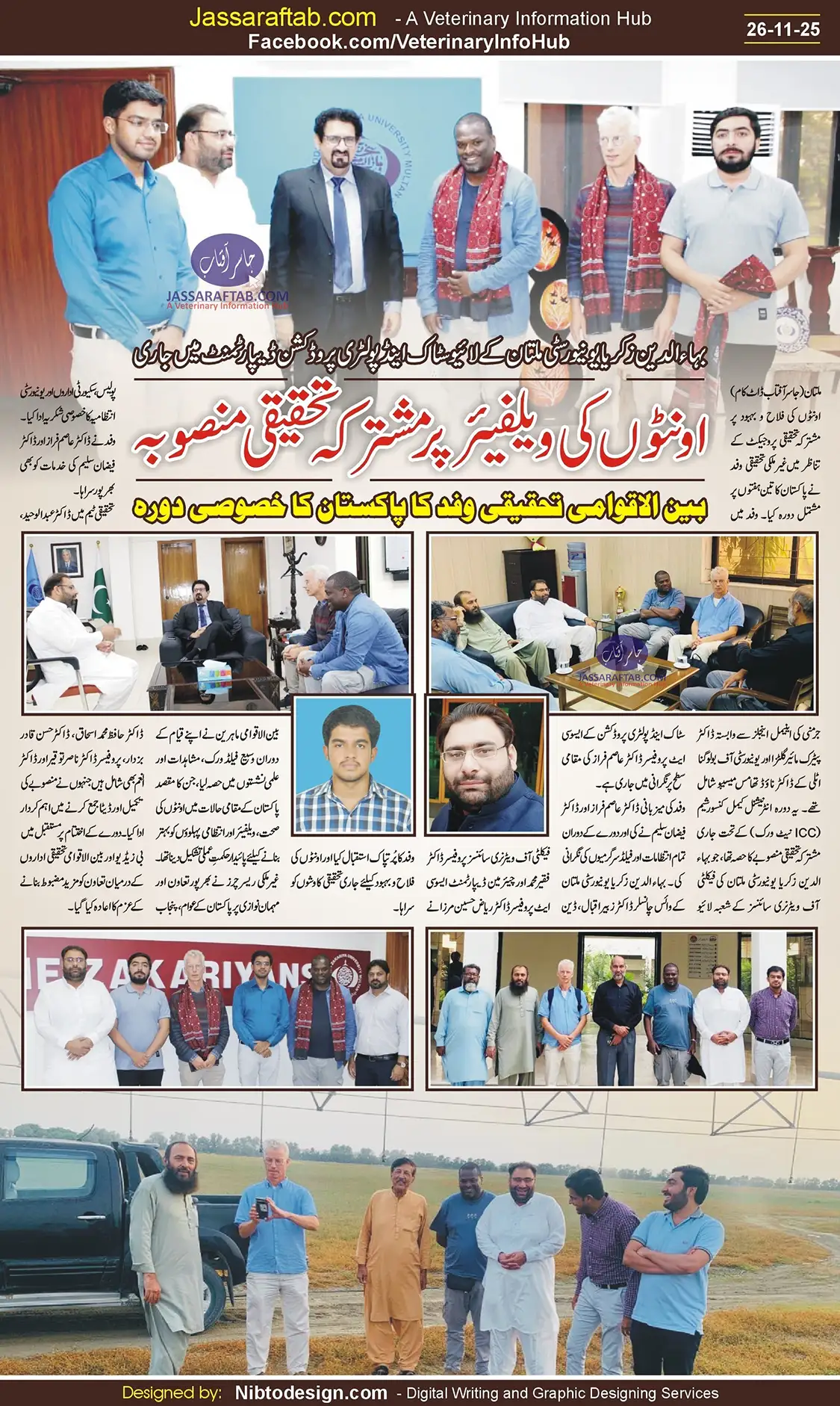
Foreign Research Delegation visited Pakistan regarding a Research Project on Camel Welfare
A foreign research delegation visited Pakistan for a three-week visit as part of a joint research project on camel welfare. The delegation included Dr. Patrick Mayer Glatz from Animal Angels, Germany, and Dr. Naud Thomas Mesibo from the University of Bologna, Italy. The visit was part of a joint camel research project under the International Camel Consortium Network (ICC Network). It is being conducted under the local supervision of Dr. Asim Faraz, Associate Professor, Department of Livestock and Poultry Production, Faculty of Veterinary Sciences, Bahauddin Zakaria University, Multan.


The delegation was hosted by Dr. Asim Faraz and Dr. Faizan Saleem and supervised all the arrangements and field activities during the visit. Vice Chancellor BZU Multan Prof. Dr. Zubair Iqbal, Dean Faculty of Veterinary Sciences Prof. Dr. Faqir Muhammad and Chairman Department Associate Prof. Dr. Riaz Hussain Mirza welcomed the delegation and appreciated the ongoing research efforts for the welfare of camels.
Camel Research Project and Field Activities
The international experts participated in extensive fieldwork, observations, and academic sessions during their stay. The aim was to formulate a sustainable strategy to improve the camel health, camel welfare, and management aspects of camels in the local conditions of Pakistan. The foreign researchers expressed special gratitude to the people of Pakistan, Punjab Police, the security agencies, and the university administration for their full cooperation and hospitality. The delegation also highly appreciated the services of Dr. Asim Faraz and Dr. Faizan Saleem.
World Camel Day and Its History
The camel research project team also includes Dr. Abdul Waheed, Dr. Hafiz Muhammad Ishaq, Dr. Hassan Qadir Buzdar, Professor Dr. Nasir Tauqeer, and Dr. Anam, who played a key role in the completion of the project and data collection. At the end of the visit, the commitment to further strengthen cooperation between BZU and international research institutions in the future was reiterated.

Various Aspects of Camel Welfare
Camels have long been an integral part of Pakistan’s rural economy. They serve as companions for transport, milk and meat production, and livelihood support in arid and semi-arid regions. Due to climate change and other aspects, the focus on camel welfare has become more crucial than ever. Health, comfort, and humane treatment of camels is not only a matter of ethics but also essential for better productivity and improved livelihoods. It is also important to preserve indigenous livestock heritage.
In Cholistan, Tharparkar, Balochistan, and southern Punjab camel rearing is a tradition. Besides this camels camels also face a range of welfare challenges. These include limited access to quality feed and water, harsh environmental conditions, traditional husbandry practices, and inadequate veterinary care. Many camel owners still rely on inherited knowledge, which, although valuable, may not fully align with modern welfare standards. This gap highlights the need for training, scientific interventions, and community-based awareness programs.
Importance of Camel Welfare and Recommendations
In recent years, the importance of camel welfare has gained international attention. Collaborative research, field studies, and capacity-building initiatives are helping identify practical solutions tailored to local contexts. Improved housing, sustainable feeding systems, disease surveillance, pain-free handling, and responsible use of camels in transport and dairy are key components of emerging welfare guidelines. Furthermore, promoting camel milk as a nutritionally rich product is encouraging communities to adopt better management practices.
QASWA; Camel Milk Ice Cream in Pakistan
Better veterinary services in remote camel rearing areas should be the top priority. Mobile veterinary units, trained staff, and need based extension tools can play an important role in early disease diagnosis and timely treatment. Coordinated efforts from researchers, government institutions, local communities, and international partners is the need of time. Integration of scientific and traditional knowledge for better camel care in Pakistan can not only safeguard its camel populations but also enhance the economic well-being of the related communities.
اونٹوں کی بریڈنگ اور بیالوجی پر کتاب شائع