


International Gibbon Day | Gibbon Conservation | Forest Singers | Lesser Apes| Species of Gibbon
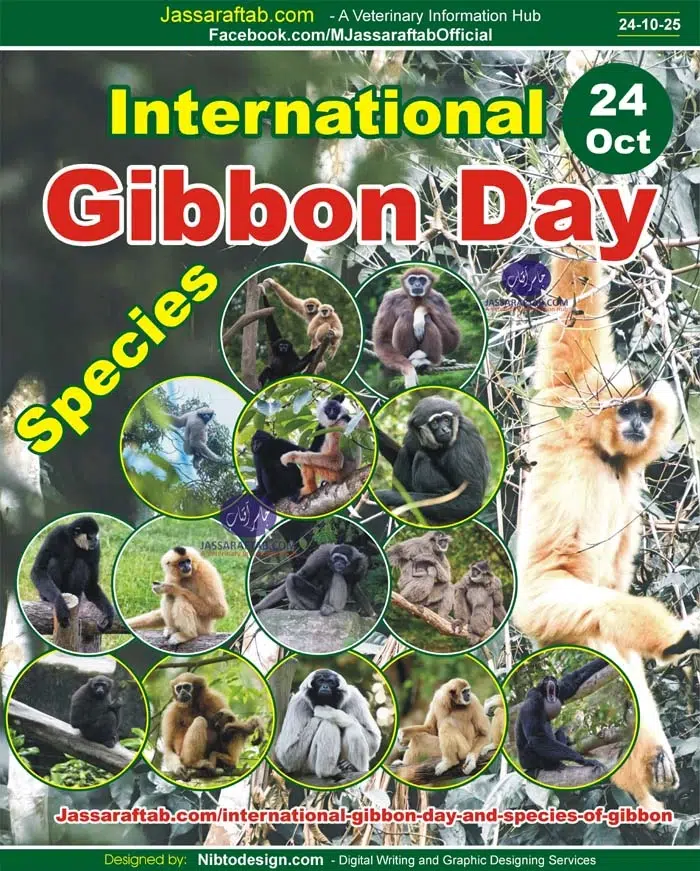
International Gibbon Day occurs on 24th October every Year to celebrate these forest singers. The day raises awareness about the species of gibbon also called lesser apes and importance of Gibbon conservation. Moreover, this day also promotes the Gibbon rehabilitation projects. In addition, gibbons face many threats in the wild, so this day helps to promote protection of their habitat. The day also focuses on the threats including poaching, illegal wildlife trade and habitat destruction.


They are native to the rain forests of Southeast, South and East Asia. So, they found in Thailand, China, Cambodia, Vietnam, Laos, Myanmar, Bangladesh, India, Malaysia, and Indonesia (including Sumatra, Java and Borneo).
History of International Gibbon Day
The IUCN Primate Specialist Group has established International Gibbon day in 2015 to raise awareness about Gibbons and species of Gibbon. It also highlights the importance of Gibbons also called forest singers and lesser apes. Additionally, the day focuses on the Gibbon conservation and Gibbon rehabilitation Projects to save them from extinction.
Purpose of International Gibbon Day
Mainly, International Gibbon Day aims to raise global awareness about gibbons, their conservation needs, and the urgent threats they face in the wild. This special day encourages people to learn about these lesser-known apes, understand their ecological importance, and take action to protect them.
Moreover, the day highlights the rapid decline of gibbon populations due to deforestation, illegal wildlife trade, and habitat fragmentation.
International Gibbon Day History – All about Gibbons
What are Gibbons?
Gibbons are apes and belong to the family Hylobatidae and they live in the rain forests of Southeast, South and East Asia. They are often called the “lesser apes” because they are smaller than great apes like gorillas and chimpanzees. Firstly, gibbons have long arms, no tails, and lightweight bodies, which help them move swiftly through trees using a motion called brachiation. Unlike monkeys, they do not have tails. Secondly, they live in monogamous family groups, consisting of a male, female, and their young, which makes their social structure different from that of most other primates.
Thirdly, they communicate through loud, melodious songs, which they use to mark territory and strengthen pair bonds. Their diet mainly includes fruits, leaves, flowers, and insects, making them important seed dispersers and vital for forest regeneration.
Sadly, gibbons are endangered due to deforestation, hunting, and illegal wildlife trade. As a result, their numbers continue to decline, and some species, like the Hainan gibbon, are critically endangered. Therefore, protecting gibbons means protecting the forests that sustain countless other species.
Species of Gibbon
There are about 20 recognized species of gibbons, and they are divided into four main genera within the family Hylobatidae. Each genus represents a different group of gibbons.
Genus Hoolock (Hoolock Gibbons)
Hoolock gibbons are the only gibbons found in South Asia, mainly in India, Bangladesh, Myanmar, and China.
Importantly, they are known for their distinct white eyebrows and loud morning calls.
Species include:
- Western Hoolock Gibbon (Hoolock hoolock) – Found in India and Bangladesh; classified as Endangered.
- Eastern Hoolock Gibbon (Hoolock leuconedys) – Found in Myanmar and China.
- Skywalker Hoolock Gibbon (Hoolock tianxing) – Discovered in 2017 in China; named after Star Wars’ Luke Skywalker.
Genus Hylobates (Typical or Lar Gibbons)
This is the largest genus of gibbons, containing seven species. These gibbons are smaller and often have distinct facial rings or markings. They live in Indonesia, Malaysia, and Thailand.
Species include:
- Lar Gibbon / White-handed Gibbon (Hylobates lar)
- Agile Gibbon (Hylobates agilis)
- Müller’s Gibbon (Hylobates muelleri)
- Abbott’s Gibbon (Hylobates abbotti)
- Silvery Gibbon (Hylobates moloch) – Found only on the island of Java; critically endangered.
- Pileated Gibbon (Hylobates pileatus) – Known for its black-and-white coloration.
- Kloss’s Gibbon (Hylobates klossii) – Lives only on the Mentawai Islands of Indonesia.
Genus Symphalangus (Siamang)
This genus has only one species the Siamang (Symphalangus syndactylus).
The siamang is the largest gibbon, easily recognized by its throat sac, which inflates to produce loud, echoing calls. It lives in Sumatra and the Malay Peninsula and plays a vital role in forest ecology.
Genus Nomascus (Crested Gibbons)
Crested gibbons are found in Vietnam, Laos, Cambodia, and southern China.
Males are usually black with a crest on their head, while females are yellow or golden, showing striking sexual dimorphism.
Species include:
- Northern White-cheeked Gibbon (Nomascus leucogenys)
- Southern White-cheeked Gibbon (Nomascus siki)
- Yellow-cheeked Gibbon (Nomascus gabriellae)
- Western Black-crested Gibbon (Nomascus concolor)
- Eastern Black-crested Gibbon (Nomascus nasutus) – One of the world’s rarest primates.
- Hainan Gibbon (Nomascus hainanus) – Critically endangered; fewer than 40 individuals remain on Hainan Island, China.
Difference Between Gibbons and Other Apes
| Feature | Gibbons (Lesser Apes) | Other Apes (Great Apes – Chimpanzees, Gorillas, Orangutans, Bonobos, Humans) |
| Scientific Family | Hylobatidae | Hominidae |
| Size | Small and lightweight | Large and heavy |
| Tail | Absent | Absent |
| Movement | Swing through trees (brachiation) | Walk or climb; some use knuckle-walking |
| Habitat | Tropical rainforests of Southeast Asia | Forests, mountains, and savannas of Africa and Asia |
| Social Structure | Small, monogamous family groups | Large and complex social groups |
| Tool Use | Rare or absent | Common; used for feeding and problem-solving |
| Intelligence | High but less advanced than great apes | Very high; show reasoning, tool-making, and emotions |
| Communication | Loud, melodious songs and calls | Complex vocalizations, gestures, and facial expressions |
| Diet | Mainly fruits, leaves, and insects | Fruits, leaves, stems, roots, and sometimes meat |
| Lifespan | 25–35 years | 40–60 years (depending on species) |
| Physical Appearance | Slender body, long arms, no crest on head | Heavier build; some have crests or large facial features |
| Behavior | Arboreal (live mostly in trees) | Semi-arboreal or terrestrial (spend time on the ground) |
| Example Species | Lar Gibbon, Siamang, Hoolock Gibbon | Chimpanzee, Gorilla, Orangutan, Bonobo, Human |
Gibbon Conservation status and International Gibbon Day
Despite their diversity, all gibbons face serious threats from habitat loss and illegal trade. Therefore, protecting these species is essential to safeguard Asia’s rainforests and the biodiversity within them. In fact, gibbons are among the most endangered primates in the world. According to the International Union for Conservation of Nature (IUCN) Red List, all gibbon species are threatened with extinction, and most are listed as Endangered or Critically Endangered. As a result, their population continues to decline rapidly due to habitat destruction, hunting, and illegal trade.
For example, Hainan crested gibbons (Nomascus hainanus) remain fewer than 30 in the wild. This species is considered the most endangered primate in the world. To combat this crisis, many dedicated organizations around the world are working tirelessly to protect gibbons, their habitats, and their future generations. These groups focus on rescue, rehabilitation, reintroduction, habitat protection, community education, and research.
However, these organizations include Gibbon Rehabilitation Project (GRP), Wildlife Friends Foundation Thailand (WFFT), Gibbon Conservation Alliance (GCA) in Switzerland, Gibbon Species Survival Plan, Borneo Nature Foundation (BNF) Indonesia, Gibbon Conservation Center (GCC) United States, and Hainan Gibbon Project (Kadoorie Conservation China).
Similarly, International Gibbon Day educates people about these forest singers also called lesser apes.
The Gibbon Rehabilitation Projects
Gibbon Rehabilitation Projects (GRePs) are Malaysia’s first dedicated small ape rehabilitation centers. These Gibbon Rehabilitation Projects are specialized conservation programs that rescue, rehabilitate, and reintroduce gibbons back into their natural habitats. Thus, these projects play a vital role in protecting endangered gibbon species and restoring wild populations that have been affected by hunting, illegal pet trade, and habitat loss.
Specifically, the Malaya GReP, founded in 2013 in Raub, Pahang, and the Borneo GReP, established in 2022 in Kota Belud, Sabah, both work tirelessly to care for orphaned and captive gibbons and prepare them for a safe return to the wild. Correspondingly, these projects focus on providing proper nutrition, medical care, behavioral rehabilitation, and re-wilding training.
Furthermore, this helps gibbons to regain their natural instincts and survival skills. The goal is to ensure that each gibbon is physically and psychologically ready before release. According to IUCN guidelines, gibbons must meet seven specific criteria before they can be successfully reintroduced into the wild.
In conclusion, the Malaysian Gibbon Rehabilitation Projects represent a vital effort to restore the lives of abused primates and ensure that gibbons can once again thrive as part of their natural ecosystems.
FAQS about International Gibbon Day and Gibbons
What is the significance of International Gibbon Day?
International Gibbon Day, observed on October 24th, aims to raise awareness about gibbons, their importance in biodiversity, and the threats they face in the wild such as habitat destruction, poaching, and illegal trade. Further, it also promotes gibbon conservation. Even more, it raises awareness about species of gibbon.
What are gibbons and what makes them unique among primates?
Gibbons are small apes belonging to the family Hylobatidae, known for their long arms, swift tree movement through brachiation, melodious songs, monogamous social groups, and their role as seed dispersers in forests.
How many species of gibbons are recognized and what are their main groups?
There are about 20 recognized gibbon species divided into four main genera: Hoolock, Hylobates, Symphalangus, and Nomascus, each with distinct characteristics and geographic distributions.
In what regions are gibbons naturally found?
Gibbons are native to Southeast, South, and East Asia, inhabiting rainforests in countries such as Thailand, China, Cambodia, Vietnam, Laos, Myanmar, Bangladesh, India, Malaysia, and Indonesia.
What efforts are being made to conserve gibbons and their habitats?
Various organizations work on rescue, rehabilitation, habitat protection, community education, and research for gibbon conservation, including dedicated rehabilitation projects like Gibbon Rehabilitation Projects in Malaysia, which aim to help endangered species recover and re-enter their natural environment.


